This content is provided for informational purposes only and does not constitute financial, investment, legal, or tax advice. All investment decisions are at the sole discretion of the reader. Please be aware that all investments involve risk, including the potential loss of principal, and historical performance does not guarantee future results.
When major earnings reports or critical corporate news break for equities like Tesla or Nvidia over the weekend, traditional market participants must wait until Monday morning execution windows open. In contrast, digital asset markets operate continuously, highlighting structural divergences in how liquidity and trading hours are managed across global financial systems. As market infrastructure evolves, the concept of Real World Asset (RWA) tokenization has emerged as a focal point for institutional and retail investors seeking to bridge traditional finance with distributed ledger technology.
[Author's Perspective]
Having observed decades of market infrastructure shifts, I have learned to view claims of frictionless financial revolutions with a balanced mix of optimism and skepticism. The friction inherent in legacy financial systems—such as T+2 settlement cycles and heavy intermediary layers—is real and costly. However, migrating complex real-world assets onto public or permissioned blockchains does not magically erase risk; it merely shifts it from clearinghouses to code, smart contracts, and evolving regulatory frameworks. Seasoned market participants understand that while tokenization could reshape asset mobility, navigating the transition requires careful attention to counterparty risk, systemic liquidity, and regulatory compliance.
1. What is the Tokenization of Stock Markets, RWA (Real World Asset)?
① The RWA Megatrend: Absorbing Traditional Finance On-Chain

Real World Asset (RWA) tokenization involves issuing digital tokens on a blockchain that represent ownership or claims on traditional financial instruments, such as government bonds, real estate, and equities. While early cryptocurrency markets focused primarily on native digital assets, the RWA megatrend seeks to bring portions of the multi-trillion-dollar traditional real economy on-chain.
- Operational Inefficiencies in TradFi: Traditional markets rely on complex networks of intermediaries, clearinghouses, and depositories, often resulting in prolonged settlement cycles and administrative friction.
- The 24/7 Liquidity Advantage: Proponents suggest that blockchain rails could enable continuous, borderless trading and settlement, freeing capital from traditional market hours and geographic boundaries.
- Risk and Security Considerations: Despite potential efficiency gains, tokenized real-world assets introduce unique vulnerabilities, including smart contract bugs, legal enforceability risks across international jurisdictions, and potential liquidity bottlenecks during periods of high market stress.
2. Institutional Participation and Key Market Players
Global financial institutions are increasingly engaging with tokenized asset frameworks to capture operational efficiencies. A combination of traditional asset managers and blockchain-native protocols currently anchors the RWA sector:
3. Implications of Stock Tokenization
The tokenization of equities represents a potential structural evolution in how ownership rights are recorded and transferred. By migrating assets from centralized institutional ledgers onto standardized blockchain networks, market participants could theoretically engage in peer-to-peer transfers without traditional intermediaries.
However, analysts caution that realizing this vision depends entirely on overcoming significant regulatory hurdles, establishing robust cross-border legal protections, and ensuring that underlying asset custodians maintain uncompromised solvency. While the theoretical architecture promises a financial protocol revolution, practical implementation will likely proceed through phased, highly regulated institutional frameworks rather than immediate, frictionless decentralization.
2. The Mechanics of Stock Trading: Why Cash Withdrawals Experience Settlement Lags
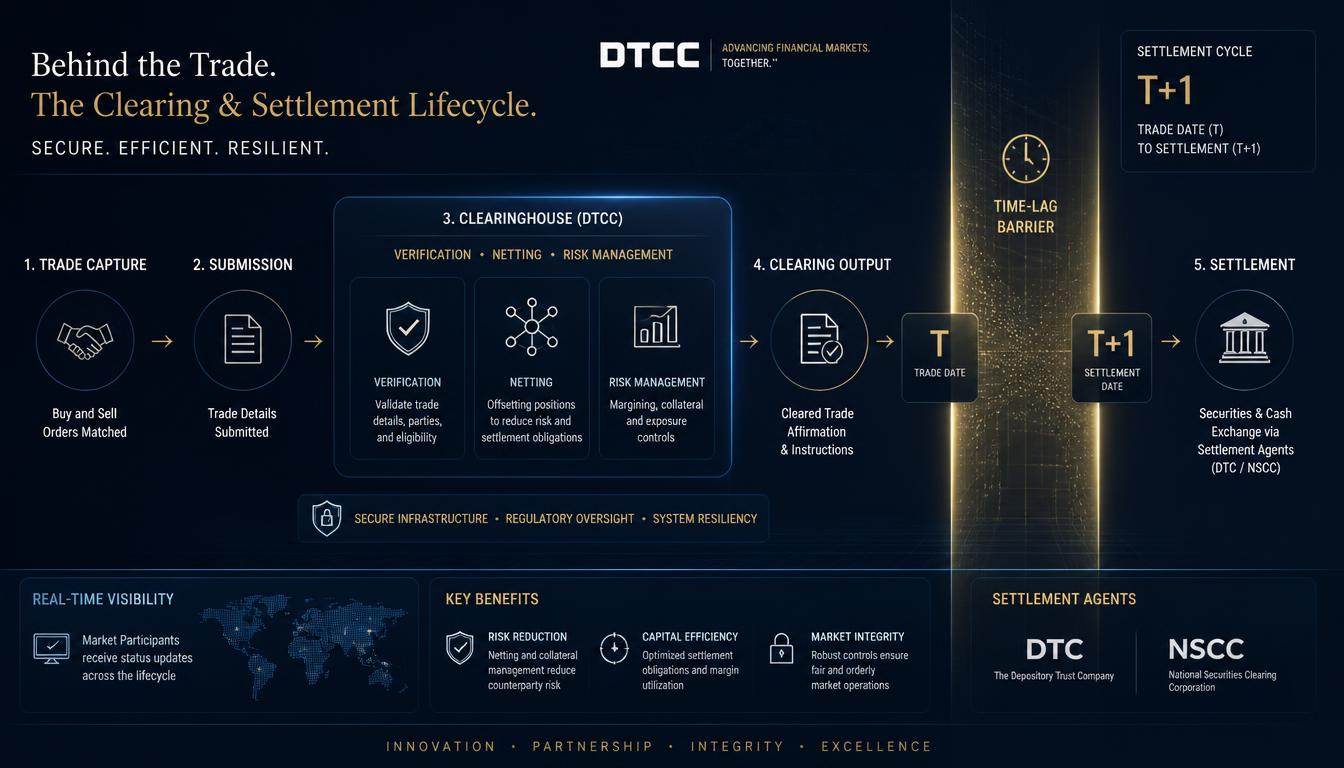
When market participants execute a sell order on a brokerage application, trade confirmation notifications typically appear almost instantaneously. However, accessing the actual cash proceeds for withdrawal often requires a multi-day waiting period. This operational lag is driven by the backend processes of modern securities markets: clearing and settlement.
The Three-Step Backend Architecture
Examining the U.S. financial market baseline reveals a multi-layered verification structure:
- Trade Execution: Matching engines on exchanges (such as the NYSE or NASDAQ) pair buy and sell orders, completing the contractual trade.
- Clearing and Netting: Central clearing organizations, such as the Depository Trust & Clearing Corporation (DTCC) through the National Securities Clearing Corporation (NSCC), step in to cross-check millions of daily transactions. A netting process offsets opposing obligations across brokerages to calculate final net delivery requirements.
- Settlement and Legal Transfer: Final ownership of securities (historically registered under depositories like Cede & Co.) and funds (USD) officially transfers. While markets historically operated on a T+2 settlement cycle, regulatory bodies have shifted standard workflows to T+1 to mitigate counterparty and systemic credit risks.
Global Settlement Cycles and Infrastructure Comparison
Clearing timelines and cash withdrawal availability vary across international regulatory jurisdictions:
Structural Drivers of Settlement Lags
Even as major jurisdictions transition toward T+1 cycles, instantaneous settlement remains constrained by structural requirements. Legacy financial systems rely on continuous reconciliation across central banks, central securities depositories, commercial banks, and individual brokerages.
- Counterparty and Default Protection: Multi-day verification protocols act as institutional safeguards designed to minimize settlement default risks, operational errors, and fraudulent transfers.
- Traditional vs. Decentralized Rails: While digital asset networks often utilize immediate execution and settlement mechanics, traditional financial systems prioritize multi-party ledger reconciliation, which analysts note introduces inherent structural friction while providing institutional legal recourse.
3. Breaking Space-Time Limits with Blockchain Infrastructure: The Future Roadmap

As the financial sector evaluates the integration of distributed ledger technology (DLT), market observers outline potential transitional phases for Real World Asset (RWA) tokenization and equity settlement.
Current State of RWA Stock Tokenization
The initial wave of RWA adoption has predominantly focused on cash-equivalent instruments rather than equities directly:
- Government Bonds and MMFs: Tokenized short-term debt and money market funds—such as BlackRock’s BUIDL and Franklin Templeton’s FOBXX—have experienced notable adoption on public chains, providing on-chain yield alternatives.
- Equities and Transitional Sandboxes: Direct on-chain public trading of physical equities continues to encounter regulatory boundaries across major jurisdictions. However, protocols and regulatory sandzones are actively testing tokenized wrappers and fractional investment models.
- Risk and Regulatory Considerations: While tokenized asset infrastructure matures, participants face regulatory fragmentation, varying cross-border compliance mandates, and liquidity bottlenecks during periods of high market stress.
Phased Stock Tokenization Roadmap and Timeline
Industry projections suggest that the integration of traditional equities onto blockchain rails could progress through several phased milestones:
- Phase 1: Hybrid Integration Era (2026 – 2027)
- Characteristics: Centralized brokerages and distributed ledger networks coexist. Central clearing institutions could introduce internal DLT solutions to compress settlement cycles (supporting T+1 frameworks). Blue-chip equities may see experimental tokenized wrappers deployed within controlled environments.
- Risk Factors: Integration friction between legacy clearing houses and blockchain middleware introduces operational vulnerabilities and complex data reconciliation challenges.
- Phase 2: Institutional STO and Expanded Trading Era (2027 – 2028)
- Characteristics: Security Token Offering (STO) regulations could see further refinement across key financial hubs. Alternative trading systems may explore extended session structures under evolving regulatory supervision.
- Risk Factors: Regulatory delays or conflicting cross-border compliance standards could slow the institutional migration of tokenized securities.
- Phase 3: Fully On-Chain Era (2028 and Beyond)
- Characteristics: Proponents envision closer convergence between traditional exchange infrastructure and public blockchain networks, enabling continuous settlement features via stablecoin rails.
- Risk Factors: Achieving systemic scale across global equity markets requires universal consensus, robust custody solutions, and mitigation of smart contract or bridge exploit risks.
Traditional Finance vs. Tokenization Market Dominance Scenarios
To illustrate how institutional adoption could impact market structures, analysts frequently model transitional scenarios comparing traditional centralized ledgers with tokenized RWA frameworks:
Note: These scenario projections reflect macroeconomic adoption models rather than definitive targets, highlighting the potential trajectories of market infrastructure evolution under varying regulatory and technological conditions.
4. Key RWA Ecosystems and Infrastructure Tokens to Watch (Top 12 by Market Cap & Weight)
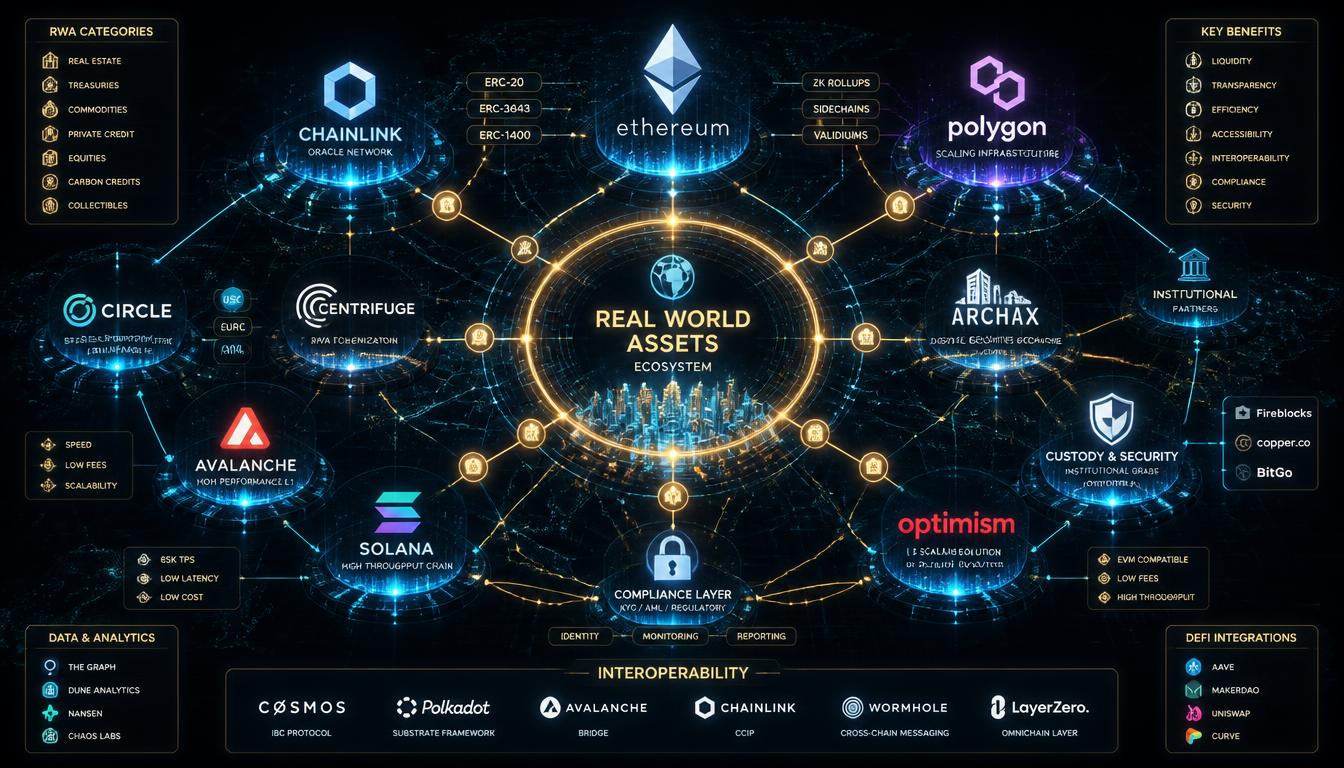
Tier 1: Global Liquidity and Layer-1 Payment Infrastructure
- Ethereum ($ETH)
- Role: Frequently viewed as a primary settlement layer for tokenized assets, with a significant portion of on-chain funds and sovereign debt instruments operating on its mainnet and Layer-2 networks.
- Risk Assessment: Ethereum remains exposed to network congestion during high-volatility periods, gas fee volatility, and smart contract execution risks across associated protocols.
- Solana ($SOL)
- Role: Functions as a high-performance RWA hub capable of supporting high throughput and low transaction fees for large-scale user bases.
- Risk Assessment: Historical network outages, validator centralization concerns, and execution vulnerabilities remain key operational risks.
- XRP / Ripple ($XRP)
- Role: Positioned within cross-border liquidity bridging and interbank settlement architectures, interfacing with legacy messaging frameworks.
- Risk Assessment: Adoption velocity depends heavily on complex regulatory developments, banking consensus, and competitive pressures from alternative central bank digital currency (CBDC) rails.
- Stellar ($XLM)
- Role: Serves as an asset issuance network utilized by institutional asset managers for issuing tokenized bond funds.
- Risk Assessment: Lower developer mindshare in broader decentralized finance (DeFi) ecosystems compared to EVM-compatible chains can limit secondary liquidity depth.
Tier 2: Ethereum Layer-2 (L2) Scaling Infrastructure
- Arbitrum ($ARB)
- Role: An Ethereum Layer-2 scaling solution providing high throughput and reduced transaction costs, supporting high-frequency financial applications.
- Risk Assessment: L2 networks introduce technical dependencies on centralized sequencers, potential bridge exploit vectors, and smart contract upgrade risks.
- Optimism ($OP)
- Role: A modular L2 infrastructure provider focusing on a "Superchain" architecture designed to unify enterprise and financial applications.
- Risk Assessment: Ecosystem fragmentation, cross-chain communication vulnerabilities, and governance execution risks remain ongoing considerations.
Tier 3: Oracles, Enterprise, and Finance-Specialized Infrastructure
- Chainlink ($LINK)
- Role: Provides decentralized oracle networks and cross-chain interoperability protocols (CCIP) designed to supply off-chain data—such as asset prices and interest rates—to smart contracts.
- Risk Assessment: As infrastructure rather than a direct asset claim, LINK is exposed to competition from emerging oracle providers and reliance on secure data feeds.
- Avalanche ($AVAX)
- Role: Features customizable "Evergreen Subnets" tailored for regulated financial institutions seeking hybrid public-private RWA networks.
- Risk Assessment: Subnet fragmentation and variable adoption rates among traditional financial institutions present long-term execution uncertainties.
- Hedera ($HBAR)
- Role: Utilizes a hashgraph consensus model to support enterprise-grade tokenization proofs-of-concept with traditional financial institutions.
- Risk Assessment: Enterprise sales cycles are characteristically long, and institutional adoption depends heavily on sustained commercial execution rather than speculative retail volume.
Tier 4: Specialized Protocols and DeFi Gateways
- Ondo Finance ($ONDO)
- Role: Connects tokenized short-term U.S. treasuries and real-world equities to decentralized finance ecosystems, acting as a gateway for institutional yields.
- Risk Assessment: Exposed to interest-rate risk, regulatory shifts regarding tokenized securities, and secondary market liquidity constraints.
- Sky (Formerly MakerDAO, $SKY)
- Role: Integrates traditional bond and debt portfolios into protocol reserves, bridging conventional yields into on-chain liquidity pools.
- Risk Assessment: Protocol governance risks, macroeconomic yield fluctuations, and collateral liquidation dynamics during market downturns require continuous monitoring.
- Quant ($QNT)
- Role: Operates the "Overledger" operating system designed to connect distributed ledgers with legacy institutional banking systems.
- Risk Assessment: Enterprise-sales-driven revenue models can be difficult to independently verify, and transaction volumes on interoperability layers can fluctuate based on macro sentiment.
-
- As real-world asset (RWA) tokenization scales, market activity increasingly concentrates around major Layer-1 networks, Ethereum Layer-2 scaling solutions, and specialized infrastructure protocols. Analysts note that these protocols serve distinct functions within the emerging digital financial stack, though each carries unique technical, operational, and regulatory risks.
📊 Summary Comparison Table of Top 12 RWA Ecosystem Tokens
| Tier Category | Token Name (Ticker) | Core Role & Weight within the RWA Ecosystem |
| Tier 1 (Main Layer & Payment) |
Ethereum ($ETH) | Central gravity well of on-chain finance and final security base where the majority of tokenized assets operate |
| Tier 1 (Main Layer & Payment) |
Solana ($SOL) | Ultra-fast, low-fee high-performance RWA hub handling massive retail and institutional throughput seamlessly |
| Tier 1 (Main Layer & Payment) |
XRP ($XRP) | Liquidity bridge linked with global banking and CBDC rails to handle cash-equivalent settlement during asset transfers |
| Tier 1 (Main Layer & Payment) |
Stellar ($XLM) | Premier asset issuance rail utilized for issuing and circulating Wall Street institutional on-chain bond funds |
| Tier 2 (Ethereum L2) |
Arbitrum ($ARB) | L2 scaling network with overwhelming TVL supporting high-frequency equity trading and micro-transactions |
| Tier 2 (Ethereum L2) |
Optimism ($OP) | Modular L2 infrastructure empowering institutions to build custom STO platforms via a Superchain vision |
| Tier 3 (Finance Infrastructure) |
Chainlink ($LINK) | The oracle standard safely feeding real-time stock prices and off-chain market data onto the blockchain |
| Tier 3 (Finance Infrastructure) |
Avalanche ($AVAX) | Evergreen Subnets enabling regulated financial institutions to securely build compliance-ready RWA networks |
| Tier 3 (Finance Infrastructure) |
Hedera ($HBAR) | Hashgraph consensus-based network optimized for Wall Street enterprise-grade RWA PoC implementations |
| Tier 4 (Specialized Protocol) |
Ondo Finance ($ONDO) | Leading gateway connecting tokenized real-world equities and U.S. treasuries to DeFi and retail wallets |
| Tier 4 (Specialized Protocol) |
Sky / MakerDAO ($SKY) | Protocol giant incorporating massive real-world bonds and secure debt portfolios as backing reserves |
| Tier 4 (Specialized Protocol) |
Quant ($QNT) | Overledger OS connecting blockchains safely and multi-dimensionally with legacy institutional banking systems |
5. Market Capitalization versus Trading Volume: The Infrastructure Engine Model

[Author's Perspective]
Having navigated decades of market structure evolution, I have often encountered skepticism regarding whether digital asset networks possess the foundational capacity to support global traditional finance. The core misconception stems from viewing blockchain market capitalization as a static warehouse of wealth rather than a high-velocity settlement engine. However, seasoned investors must remain realistic: high token velocity and infrastructure efficiency do not immunize protocols against severe volatility, regulatory pushback, or execution risk. Understanding how rails process value without holding it permanently is vital, but so is recognizing the complex operational hurdles ahead.
The Highway and Toll Analogy
- Governance and Gas Tokens: Native infrastructure assets (such as Ethereum's $ETH or Solana's$SOL) function as the operational "fuel" and toll mechanisms required to process transactions across decentralized networks.
- Tokenized Assets as Cargo: Tokenized equities or real-world assets represent the cargo moving across the network.
- Velocity Over Storage: Because infrastructure networks charge fractional fees per transaction and do not permanently store the total value of all goods moving across them, a relatively modest market capitalization can support astronomical trading volumes through high transaction velocity.
- Risk and Operational Considerations: While high velocity enables efficient scaling, reliance on network throughput introduces risks related to congestion, validator centralization, and unexpected gas fee spikes during high-volatility events.
Asset-Backed RWA Versus Liquidity Bridge Mechanisms
Tokenization and blockchain utility frameworks operate through distinct operational models:
- Asset-Backed RWA (Equities and Real Estate):
- Mechanism: Ownership rights are housed in special purpose vehicles (SPVs) and represented by digital tokens (e.g., $TSLA tokens).
- Settlement Medium: Transactions are typically settled using value-pegged stablecoins (USDC, USDT), while governance tokens are consumed solely as execution fees.
- Liquidity Bridge RWA (Cross-Border Remittances and ODL):
- Mechanism: Bridge assets (such as XRP or XLM) act as temporary liquidity conduits during cross-border transfers, instantly converting source fiat to the bridge asset and auto-converting to destination fiat within seconds.
- Velocity Impact: Because the asset is held only momentarily, a lower market capitalization can theoretically clear large cumulative volumes through rapid turnover.
- Risk Factors: Liquidity bridges remain exposed to counterparty exchange risk, slippage during low-liquidity periods, and regulatory uncertainty surrounding cross-border fiat-to-crypto gateways.
6. Institutional Integration Scenarios and Liquidity Models
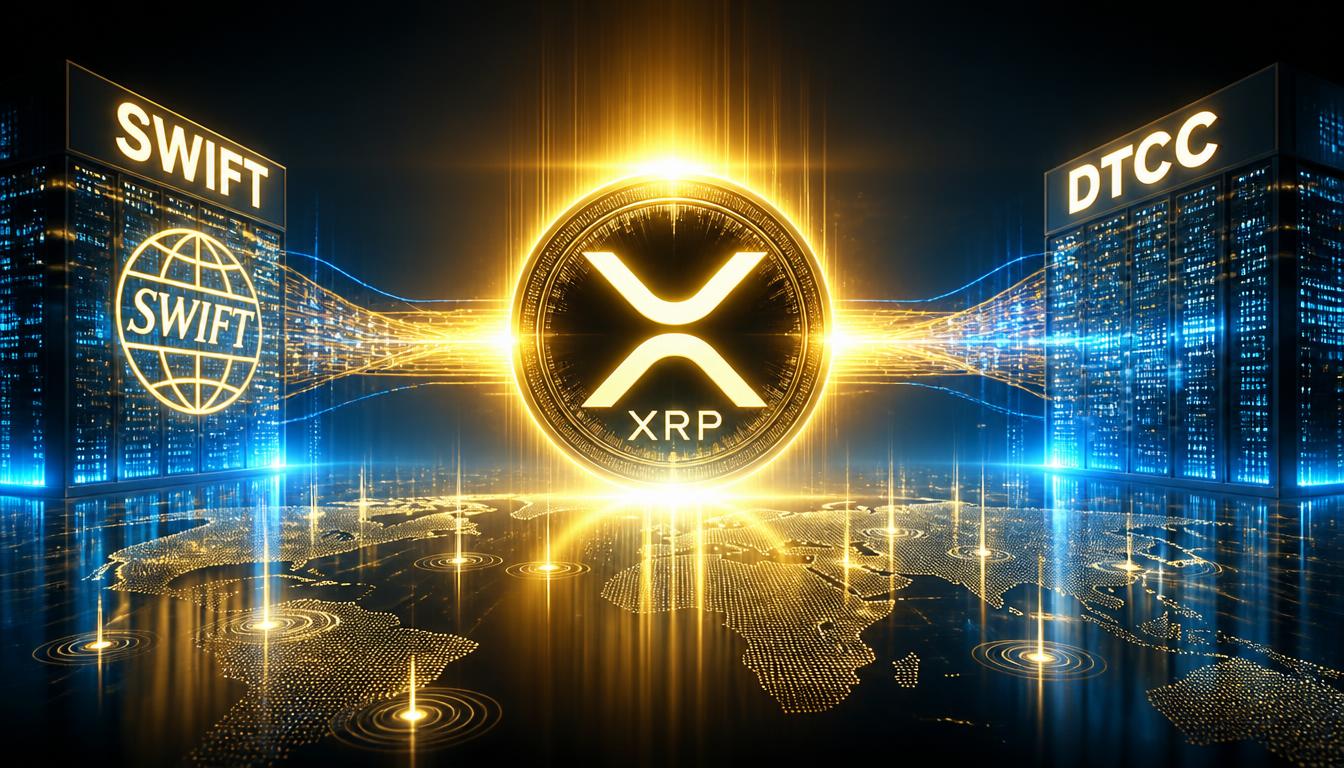
As digital infrastructure intersects with legacy financial arteries such as SWIFT and the Depository Trust & Clearing Corporation (DTCC), analysts evaluate how capital demands could impact asset valuation models.
Liquidity Strength (LS) Frameworks
One widely circulated framework for thinking about this is "Liquidity Strength" (LS) — a model that gained attention after a Wells Fargo employee outlined it in a personal social media post back in 2023, arguing that processing trillions of dollars in daily institutional volume at low nominal token prices could create liquidity gridlocks. It's worth noting this was a personal, non-institutional viewpoint rather than official Wells Fargo research, and the price scenario attached to it at the time has not materialized in the years since. Still, the underlying question the model raises — whether nominal token prices can realistically support the transaction volumes of global settlement networks — remains a legitimate one for the space to work through.
XRP Value Estimation Models by Market Share Scenarios
Based on theoretical macroeconomic liquidity absorption models and structural reverse-calculations relative to SWIFT and DTCC clearing volumes, various analytical projections map out potential valuation ranges under different institutional adoption levels:
Note: These model ranges reflect speculative theoretical frameworks rather than guaranteed outcomes, and depend heavily on broad regulatory acceptance and institutional consensus.
Phased Institutional Integration Timeline
The transition of digital asset infrastructure into traditional financial plumbing is projected by analysts to unfold across distinct phases:
- Phase 1 (2026 – 2027): Regulatory Clarity and Proofs of Concept
- Focus: Resolution of regulatory frameworks enables commercial banks to scale On-Demand Liquidity (ODL) pilots for international remittances and asset transfers.
- Phase 2 (2027 – 2030): Network Convergence
- Focus: Alignment with messaging standards like SWIFT's ISO 20022 facilitates direct linking between blockchain bridges and legacy messaging systems, potentially catalyzing primary adoption phases.
- Phase 3 (2030 and Beyond): Universal Clearing Standards
- Focus: Transition of securities settlement rails and cross-border capital flows toward distributed ledger environments, establishing on-chain infrastructure as a core component of global market clearing.
The ongoing shift toward tokenized asset infrastructure illustrates a broader evolution in how global capital is recorded, routed, and settled. While theoretical models highlight the potential for significant valuation adjustments under high institutional adoption scenarios, investors must remain vigilant regarding regulatory roadblocks, technological hurdles, and macroeconomic volatility inherent in systemic financial transitions.
7. Transitioning from Speculation to Utility: The "Switch On" Era

For veteran market participants, a central question remains: When will infrastructure asset prices reflect actual network utilization, fee generation, and economic throughput rather than short-term speculative sentiment?
Market analysts suggest that this maturation process—often conceptualized as a shift toward utility-driven pricing—depends on several structural prerequisites and macro-level catalysts.
Core Conditions for a Utility-Driven Market
For distributed ledger networks to transition away from pure speculative dependence, specific economic and institutional thresholds generally must be met:
- Scale Beyond Experimental Use: Tokenized asset volumes and on-chain settlements would need to reach a scale where baseline transaction fees and network demand generate sustained organic revenue, reducing vulnerability to artificial market maker manipulation.
- Cash-Flow-Aligned Tokenomics: Regulatory and protocol frameworks increasingly explore mechanisms where network activity directly influences token supply—such as automated fee-burning models or mandatory institutional staking structures designed to lock up circulating inventory.
- Institutional Capital Integration: Systematic participation from institutional entities—such as asset managers, corporate treasuries, and pension funds—paying predictable smart contract execution fees could gradually shift market pricing power toward long-term fundamental analysis.
Risk Assessment: While these mechanisms aim to establish economic floors, they also expose networks to systemic smart contract failures, unforeseen code vulnerabilities, and regulatory shifts that could disrupt automated tokenomics or staking models.
Phased Transitional Timeline (2026 – 2030+)
Observers project that the shift toward institutional and utility-backed pricing will likely unfold through distinct operational phases rather than an immediate market reset:
- Phase 1: The Hybrid Transition (2026 – 2027)
- Market Conditions: As tokenized government debt, money market funds, and early equity wrappers expand, on-chain transaction volumes and fee generation could test previous highs.
- Price Characteristics: Markets may remain sensitive to traditional liquidity cycles, yet robust fee inflows and burn mechanisms could provide stronger support levels during broader market corrections.
- Risk Factors: Regulatory friction and cross-border compliance uncertainties during this transitional window may introduce sharp volatility spikes.
- Phase 2: The Tipping Point and De-Speculation (2027 – 2030)
- Market Conditions: Coinciding with potential regulatory developments—such as updated settlement frameworks and security token offering (STO) guidelines—broader classes of traditional financial assets may operate on-chain.
- Price Characteristics: Asset valuations could increasingly correlate with measurable network metrics, such as daily transactional throughput, fee revenues, and locked supply ratios.
- Risk Factors: Scaling challenges, network congestion, and potential cross-chain bridge exploits remain prominent technical risks as institutional traffic increases.
Price-Leading Scenarios and Market Anticipation
In financial markets, asset prices frequently react to structural paradigm shifts well before fundamental metrics are fully realized. Analysts outline a multi-stage anticipatory pattern:
The historical evolution of major technological and financial innovations suggests that periods of consolidation and market fatigue often precede significant structural transitions. As global financial systems evaluate the integration of distributed ledger architecture, market participants navigating these cycles must balance macroeconomic conviction with rigorous risk management, recognizing that navigating structural paradigm shifts requires both strategic patience and a clear-eyed assessment of underlying fundamentals.
Sometimes I scroll back through the historical charts of established tech giants—Google, Apple, Microsoft, Nvidia, Tesla. The smooth upward curves visible today mask years of flat, sideways trading that would have tested any investor's patience at the time.
Whether today's consolidation in tokenized infrastructure eventually gets remembered the same way is genuinely an open question — plenty of "paradigm shift" narratives in markets don't pan out as expected. If you've done the research and hold a position you understand well, the more useful discipline is probably ongoing reassessment rather than treating conviction as something to defend at all costs. Markets have a way of punishing certainty more than curiosity.