Charts are cold, communities are drowning in sighs and cynicism, and a heavy blanket of despair hangs over the space: "Liquidity is completely dead; no catalyst can save us right now."
When the majority of investors are exhausted, closing their tabs, and walking away from the market, the asset market has always pulled the trigger on a silent reversal right out of the cruelest, coldest silence.
People often believe money moves first to shift the market. But financial history proves the exact opposite. Liquidity doesn't create price action; rather, "conviction and expectation" born at the absolute trough of despair drag dormant liquidity back into the light.
Is this deafening apathy the end of the market, or is it the ultimate "valley of opportunity" ahead of a massive infrastructure paradigm shift?
1. When the Masses Look Away: How Asset Markets Reverse

The most dramatic contrast dominating the global asset market right now is the massive flood of liquidity pouring into AI sectors and traditional equities, juxtaposed against the absolute wasteland of apathy gripping the crypto market. In particular, market reactions surrounding a core U.S. regulatory battle—the CLARITY Act (H.R. 3633)—lay bare the sheer depth of despair currently haunting the crypto ecosystem.
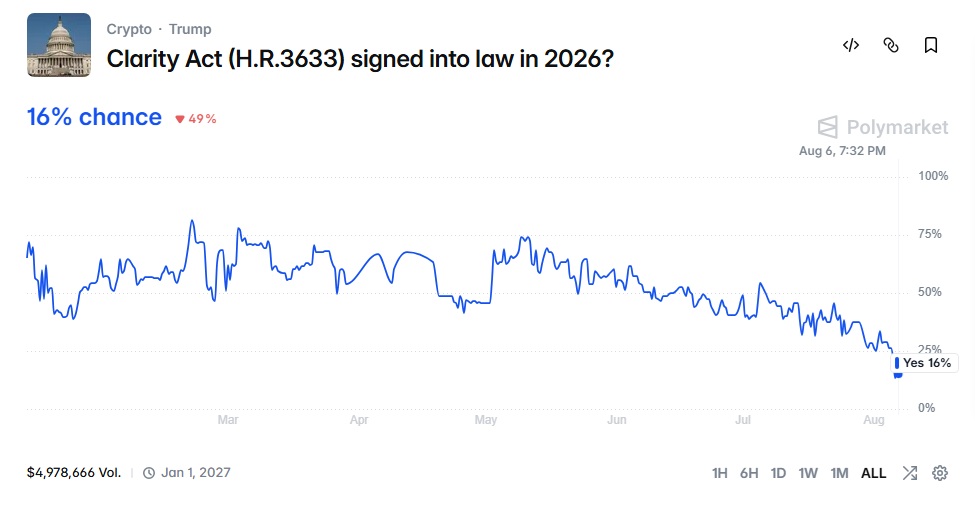
👉 Track the live market odds here: Will the Market Structure Bill (HR3633) be enacted in 2026? on Polymarket
Looking at Polymarket, the world’s leading decentralized prediction market, participant sentiment regarding the bill's passage within the year has completely collapsed. As intense partisan gridlock between Democrats and Republicans drags on right ahead of the U.S. Senate’s recess and legislative deadlines, the probability of the bill being enacted in 2026 has plummeted to an all-time low of 13% to 15%. Total cumulative trading volume for related prediction events sits stagnant at roughly $4.7 million, proving just how thoroughly the public and institutional spotlight has shifted away. Cynicism, resignation, and profound indifference reign supreme.
This exodus of mainstream attention is mirrored starkly across major exchange metrics as of early August 2026. Core pillars of global crypto liquidity—such as Binance and U.S. institutional gateway Coinbase—remain trapped in directionless consolidation without meaningful momentum. Meanwhile, South Korea's flagship exchange Upbit saw a sharp 27% day-over-day plunge in trading volume, highlighting a severe liquidity drought in local fiat markets. Conversely, traditional equity indices like the Nasdaq and the S&P 500 continue to shatter records, absorbing hundreds of billions to over a trillion dollars in daily trading volume.
The comparative breakdown below illustrates this extreme liquidity divergence across global markets as of early August 2026:
| Asset Market Segment | Key Platforms & Indices | Early August 2026 Volume & Liquidity Status | Market Participant Sentiment |
| Traditional Equities | Nasdaq & S&P 500 | Astronomical volume (Daily averageing $500B to over $1T+) | Heavy capital concentration in AI/semiconductors, strong FOMO forming |
| Global Crypto (CeFi) | Binance | Stagnant spot & derivatives volume (Limited inflows outside selective dip-buying) | Widespread fatigue due to a lack of clear leading narratives |
| U.S. Institutional Gateway | Coinbase | Subdued institutional & retail volume (Retail demand locked up despite market share defense) | Dominant wait-and-see stance driven by regulatory delays |
| Regional Retail | Upbit | Sharp 24h volume drop of 27%+ (Severe liquidity crunch in fiat-won pairs) | Complete exit of the general public; heavy community and media slump |
Market participants have essentially wiped out any hope of institutional evolution even within prediction markets, and capital has fled crypto entirely in favor of equities and artificial intelligence. Yet, financial history has consistently proven that it is precisely in these valleys of cold silence and deep despair that the narrative of a market reversal is written, hand-in-hand with unexpected triggers.
2. Investment Philosophy : "A Watched Pot Never Boils"—The Myth of Dead Liquidity and the Law of Expectation

When the market is frozen this solid, most participants chime in: "Liquidity is bone-dry, so no matter what good news drops, prices aren't going to pop immediately." But this is a fundamental misunderstanding of how asset markets work. The history of finance has consistently proven one core truth: "Liquidity doesn't create price action; rather, expectations create liquidity."
At this crossroads of profound despair and apathy, we need to look closely at why a single politician and a single piece of legislation matter so much—and how history repeats itself.
[In-Depth Spotlight] Senator Cynthia Lummis and Her Unwavering Drive for the Clarity Act
In the U.S. Senate, the most steadfast guardian and rescue pitcher for the crypto industry is Republican Senator Cynthia Lummis of Wyoming. Serving as a key figure on the Senate Banking Subcommittee on Digital Assets, she has long blazed a lonely yet stubborn trail within U.S. politics to bring digital assets into the institutional fold.
- Deep-Rooted Dedication : Back in 2022, Senator Lummis co-authored the Responsible Financial Innovation Act (RFIA)—the first comprehensive crypto regulatory bill in the U.S.—alongside Democratic Senator Kirsten Gillibrand, laying the foundation. For years since, she has fought relentlessly to clearly demarcate jurisdictional lines between the SEC and the CFTC.
- Crossing Legislative Ridges : In May 2026, under her leadership, the Senate Banking Committee passed the Digital Asset Market Clarity Act (H.R. 3633) in a bipartisan 15–9 vote, marking a critical turning point. Following this, in July 2026, she aggressively rolled out a consolidated compromise package merging key points from both the Banking and Agriculture Committees, pushing hard to cross the legislative finish line.
- Uncompromising Will : Emphasizing that "this summer is the final window to secure America's digital asset dominance for years to come," she has shown fierce determination to skip her congressional recess, working right through the weekend to force underground negotiations and floor votes. Despite heavy partisan tug-of-wars over ethics rules and staking rewards with Democrats, her unwavering stance keeps the possibility of a "surprise trigger" alive in the back of the market's mind.
"Liquidity is Dead, So It Won't Work?" — Refuting the Myth of Liquidity with 4 Historical Precedents
The argument that "liquidity is too dry for the bill's passage to matter" is like denying that dark rainclouds gather before a storm. The seed that detonates price action in asset markets isn't cash itself—it's conviction and expectation. Let's examine four historical case studies that prove this exact phenomenon.
① Late 2023 – Early 2024 : The Cynicism Right Before the Spot Bitcoin ETF Approval
- The Situation: Exhaustion reached a peak after years of legal battles with the SEC. Pessimism ran rampant: "Institutional capital is miles away," and "This is a classic 'sell the news' event." Real liquidity sitting on the sidelines was at rock bottom.
- The Reversal: Yet, the moment expectations for approval materialized, dormant global capital rushed in overnight, opening massive floodgates that smashed previous all-time highs. Liquidity didn't move first; regulatory certainty as an expectation exploded the liquidity.
② 2008 Global Financial Crisis : The Fed's First Introduction of Quantitative Easing (QE)
- The Situation: Right after the Lehman Brothers collapse, global financial markets plunged into panic as liquidity completely evaporated. Despair dominated: "Even if the Fed prints money, it can't stop a frozen credit crunch."
- The Reversal: The moment the Federal Reserve laid out the blueprint for unprecedented unconventional monetary policy (QE), long before actual capital hit the market, the powerful expectation that "the Central Bank is backing the floor" took effect. Asset markets bottomed out and surged long before the liquidity was actually injected.
③ Late 2017 : The Anticipation of CME Bitcoin Futures Listing
- The Situation : Back when the crypto market was written off as a speculative playground for a small circle of retail gamblers, Wall Street mega-institutions wouldn't touch it with a ten-foot pole, and institutional liquidity was practically zero.
- The Reversal : When the world’s largest derivatives exchange, the CME, officially greenlit Bitcoin futures listings, a single expectation—"real Wall Street mega-money is finally coming in legally"—galvanized global retail and early capital, fueling the massive 2017 bull run.
④ March 2020 : The Fed's "Unlimited QE" Declaration Right After the Pandemic Shock
- The Situation : The COVID-19 pandemic triggered an indiscriminate crash across all global assets. Amid widespread terror that nothing would survive outside of cash, market liquidity had completely dried up.
- The Reversal : The moment the Fed signaled its ironclad will to "provide unlimited liquidity," even before the real economy showed any signs of recovery, stock and asset markets staged the sharpest V-shaped bull market in history amidst the worst depression. Prices didn't rise because liquidity was printed; the expectation that it would be printed served as the trigger that cleared the bottom.
Bitcoin Spot ETF Approval 2024 Market Impact Analysis
This video clearly breaks down from a historical perspective how the expectation of regulatory approval paved the way for massive inflows of mainstream liquidity.
3. The Clarity Act and the Guaranteed Future

3-1. What Happens If the Clarity Act Passes Tonight with 60 Votes? (Immediate Market Reaction Scenario)
In a market completely drenched in cynicism, trapped by a meager 13% probability on prediction markets, if the bill is unexpectedly brought to the Senate floor and miraculously secures 60 votes to pass, the crypto market will face an instant explosion of force:
- Ultra-Short Squeeze Explosion : The vast majority of market participants and algorithms have priced in "no passage this year," loading up on short positions or maximizing cash ratios. The moment breaking news hits of its passage, a chain-reaction panic buy will trigger as billions of dollars in short positions are forcibly liquidated, sending prices vertical.
- The Institutional Liquidity Dam Breaks : As the "regulatory risk" that held back institutional capital is finally cleared away, Wall Street financial giants and pension funds will flood in with astronomical sidelined capital via pre-prepared custody and financial infrastructure.
- Retail FOMO and Mainstream Madness : Mainstream media outlets will simultaneously headline America's seizure of digital asset supremacy. A massive wave of returning retail investors will stream back in, catapulting the market straight into a mega bull run intertwined with asset tokenization and the 4th Industrial Revolution mega-trend.
3-2. What If Legislative Efforts Stall and Congress Enters Recess? — SEC Chairman Paul Atkins’ "Project Crypto" and Chris Giancarlo’s Insights
Even if political gridlock prevents the bill from clearing the timeline before Congress enters recess, the massive macroscopic trend of the market will not break. At this juncture, we must turn our attention to SEC Chairman Paul Atkins’ independent moves and former CFTC Chairman Chris Giancarlo’s deep insights.
① SEC Chairman Paul Atkins’ "Project Crypto" and Independent Regulation
Even if Congress fails to pass the legislation, SEC Chairman Paul Atkins has made it clear he won't back down. He has fully prepared to deploy independent SEC authority to execute a comprehensive crypto market regulatory package. Through "Project Crypto," the SEC has already established clear guidelines and Safe Harbor sandbox exemptions spanning digital asset distribution, custody, and Decentralized Finance (DeFi). This means that even if legislative lawmaking is delayed, a decisive move by the top regulatory chief can unilaterally unlock a compliant distribution environment within the U.S.
② Chris Giancarlo’s Prophecy : "The Future Arrives Even Without a Bill"
Widely known as "Crypto Dad," former CFTC Chairman Chris Giancarlo dropped a blunt truth in a recent interview: "It is a tactical error for the crypto industry to stake its life entirely on whether the Clarity Act passes or fails."
- He emphasized that the financial paradigm shift powered by blockchain is an inevitable, guaranteed future that will march forward regardless of legislation. Even if the bill falls through, both the SEC and CFTC will continue to fill in the independent regulatory framework piece by piece.
- He noted that the sector most desperately in need of regulatory clarity isn't actually the crypto industry itself, but traditional banking institutions that have been holding back trillions of dollars in investments due to regulatory ambiguity.
- Therefore, a legislative failure isn't a defeat for the ecosystem; rather, it is a natural process of weeding out fearful bystanders and filtering for true builders.
Chris Giancarlo on the Clarity Act and US Crypto Regulation
This video features former CFTC Chairman Chris Giancarlo exploring the political reality of the Clarity Act and the regulatory roadmap moving forward.
4. Conclusion & Timeline : The Tangible Truth We Must Focus on Amidst the Sideways Grind
"Have patience in a brutal sideways market; time is on our side." Let’s be honest—in the middle of zero-volume apathy like today, that phrase feels like an empty echo that only irritates investors. When your portfolio is stagnant and the public has turned its back, nothing is more agonizing than vague, empty hope.
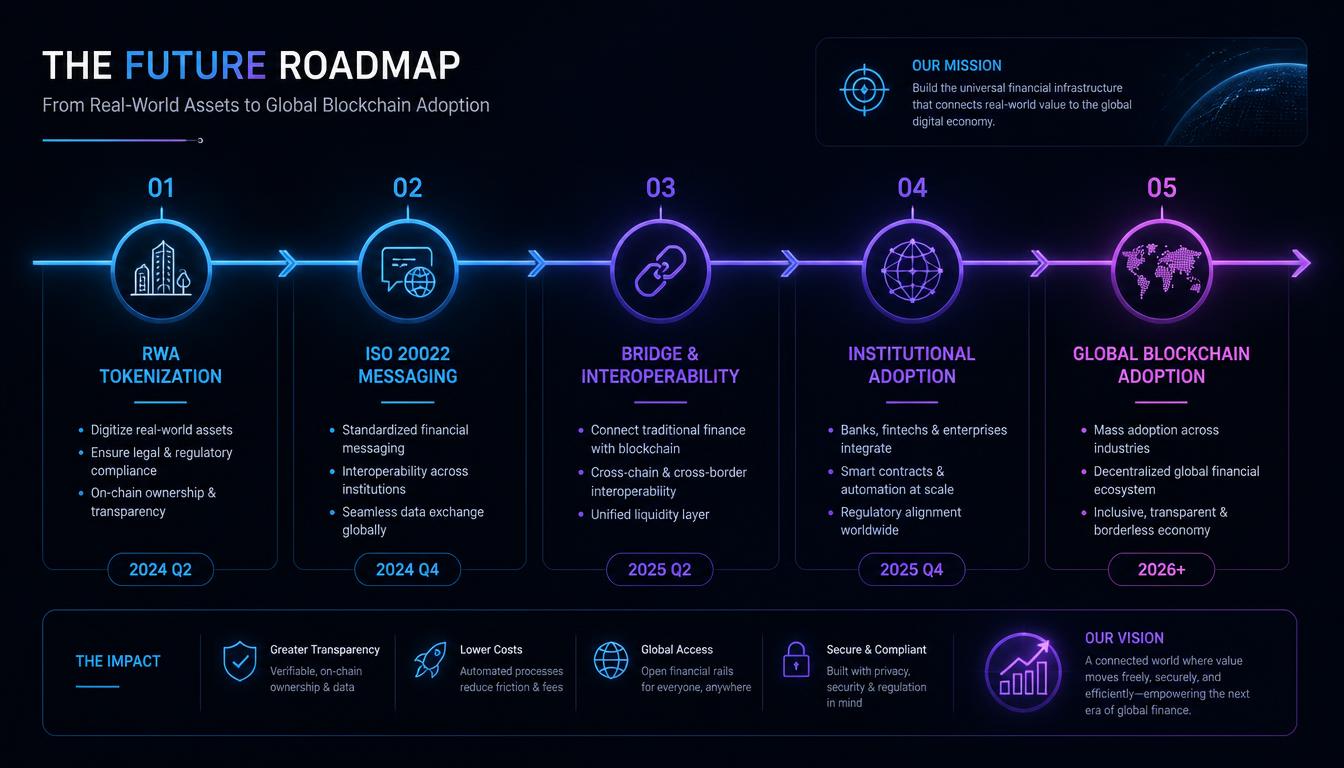
So when is the concrete, logical timeline that will actually pull us out of this dark tunnel? It’s time to look past the noise and examine the concrete schedule where speculative demand flushes out and global financial pipelines reorganize around "Real Utility"—blockchain and tokenization.
[The Real-Utility Mass Adoption Timeline] 3 Inflection Points Out of the Dark Tunnel
Phase 1. H2 2026: Live Deployment of Traditional Financial Infrastructure (DTCC & SWIFT)
- DTCC (Depository Trust & Clearing Corporation) Full Asset Tokenization Launch:
- Managing over $114 trillion in assets and processing thousands of trillions annually, the DTCC completed technical validation for its asset tokenization service, conducting limited live trading tests in July 2026 before entering its official full-scale commercial service launch in October 2026.
- Real-world assets (RWAs) like U.S. equities, ETFs, and Treasuries are now running live inside the mainstream pipeline of traditional finance—no longer just in virtual spaces.
- SWIFT ISO 20022 Mandatory Messaging Standard Switch (November 14, 2026):
- SWIFT, the backbone of global cross-border remittances, officially phases out unstructured addresses starting November 14, 2026, enforcing strict structured data and CBPR+ messaging standards.
- This shift means interbank payment infrastructure is completely transforming into a blockchain-friendly communication format supporting rich data. This serves as a decisive turning point where the practical utility and integration of ISO 20022-compliant blockchain networks and tokens explode into the spotlight.
Phase 2. Late 2026 – 2027: Regulatory Clarity and the Institutional Liquidity Dam Break
- Legislative Politics vs. Regulators' Independent Route ("Project Crypto"):
- Regardless of the congressional tug-of-war over the Clarity Act, financial authorities like the SEC (under the Paul Atkins regime) and the CFTC are completing sandboxes and guidelines that allow institutional investors to legally deploy capital.
- This is the exact window where global banks and asset managers, previously sidelined by legal risks, open up custody and commercialization services within a clarified regulatory framework.
Phase 3. Post-2027: Multi-Blockchain Mass Adoption Led by the BIS and IMF
- Commercialization of Cross-Border Real Settlement & CBDCs:
- Multi-central bank digital currency (mCBDC) and tokenized commercial bank money experiments—such as Project Agora led by the Bank for International Settlements (BIS)—are moving beyond the pilot phase and into real-world global trade settlements.
- The coin market, once a playground for speculators, is undergoing a complete structural evolution into the "Era of Mass Adoption," where global financial institutions consume blockchain as an essential utility for real-time asset settlement and cross-border remittances.
[Concluding Thoughts] When the Nature of Patience Changes
The tedious sideways grind we are experiencing right now isn't a sign that the market is dead. It is simply the most agonizing transitional phase shifting from the "Era of Speculative Bubbles" to the "Era of Infrastructure-Driven Real Utility."
Expectation is merely the trigger; what backs it up is a massive historical schedule: DTCC asset tokenization, SWIFT's ISO 20022 standard overhaul, and institutional capital execution.
There is no need to get caught up in the emotional rollercoaster of short-term news or volatile headlines. If you can clearly perceive the tangible timeline of how the financial paradigm is shifting at the end of this tunnel, you will realize that today's painful apathy is simply another name for our most definitive opportunity.
I first entered the crypto market back during the speculative mania of late 2017, stepping straight into the height of public euphoria, and I have weathered three crypto winters since then. Through those years, a few hard-earned truths became clear: you must invest in assets moving toward mass adoption; you must continuously learn to find the grounds and reasons why you hold; and you must never buy when the public is ecstatic—instead, accumulate in tranches when everyone else looks away.
The crypto winter will inevitably pass. As mentioned earlier, traditional financial infrastructure is transforming into blockchain-based systems. Political legislation and regulatory frameworks are being built. Following that, colossal pools of capital—such as sovereign wealth funds and institutional pensions—will flood into this market. It is a guaranteed future.
Establish this solid narrative and foundation, and navigate your investment journey with conviction.
[Deep Dive]
To gain a deeper understanding of macroeconomics, crypto, and institutional changes within the asset market, I highly recommend reviewing the analysis materials I have previously written.
[PART 1] "Is Your AI Just a Chatbot? Why 'AI Agents' are the New Digital Workforce Powering the Next Crypto Bull Run"
Is your AI assistant just a glorified search engine?Most people think AI stops at "Chatting." You ask a question, it gives an answer, and you move on. But that’s the old era of AI. We have officially entered the age of AI Agents—the digital workforce t
cryptoteslaglobal.com
The Institutional Counterattack: Why Big Money is Bringing Crypto Into the System
The Institutional Counterattack : Why Big Money is Bringing Crypto Into the System
The current perspective on the crypto market is sharply divided. Some are paralyzed by fear, hanging on every headline about the 'Clarity Act' (Market Structure Bill) and wondering if the party is coming to an end. Others see the current, tedious sideways
cryptoteslaglobal.com
"The Loneliness Economy: Why Tesla and Nvidia Are Betting Big on Embodied AI"
"The Loneliness Economy : Why Tesla and Nvidia Are Betting Big on Embodied AI"
1. A Global Challenge : The Demographic Cliff and the Crisis of Social Connection Currently, major economies worldwide are grappling with a structural crisis known as the "demographic cliff." This phenomenon extends far beyond mere population decline; it s
cryptoteslaglobal.com