In the complex plumbing of global finance, professional investors don't just watch headlines—they track the underlying mechanics of liquidity. While retail traders focus on price action, seasoned institutional managers watch one critical number: the Federal Reserve's Reverse Repo (RRP) balance. As we navigate the second half of 2026, understanding this facility is not just technical—it is the key to timing the next capital rotation into AI infrastructure and crypto assets.
1. The Financial Plumbing: The Origin and Purpose of Repo/Reverse Repo
To understand the RRP, one must understand its roots. The Repo market, a bedrock of finance since the late 19th century, was designed to provide safety through collateralization.
- The Repo Mechanism: It is a collateralized overnight loan. If a financial institution requires immediate liquidity, it pledges Treasury securities as collateral to secure cash, with a binding agreement to buy those securities back the next day with interest.
- Why the Federal Reserve Intervenes: Post-2008, the Fed evolved. It now acts as a central participant in this market. When the system is drowning in excess liquidity, the Fed absorbs it (Reverse Repo); when the system is starved, the Fed injects it (Repo).
2. The Mechanics: Understanding the 'Overnight Vault'
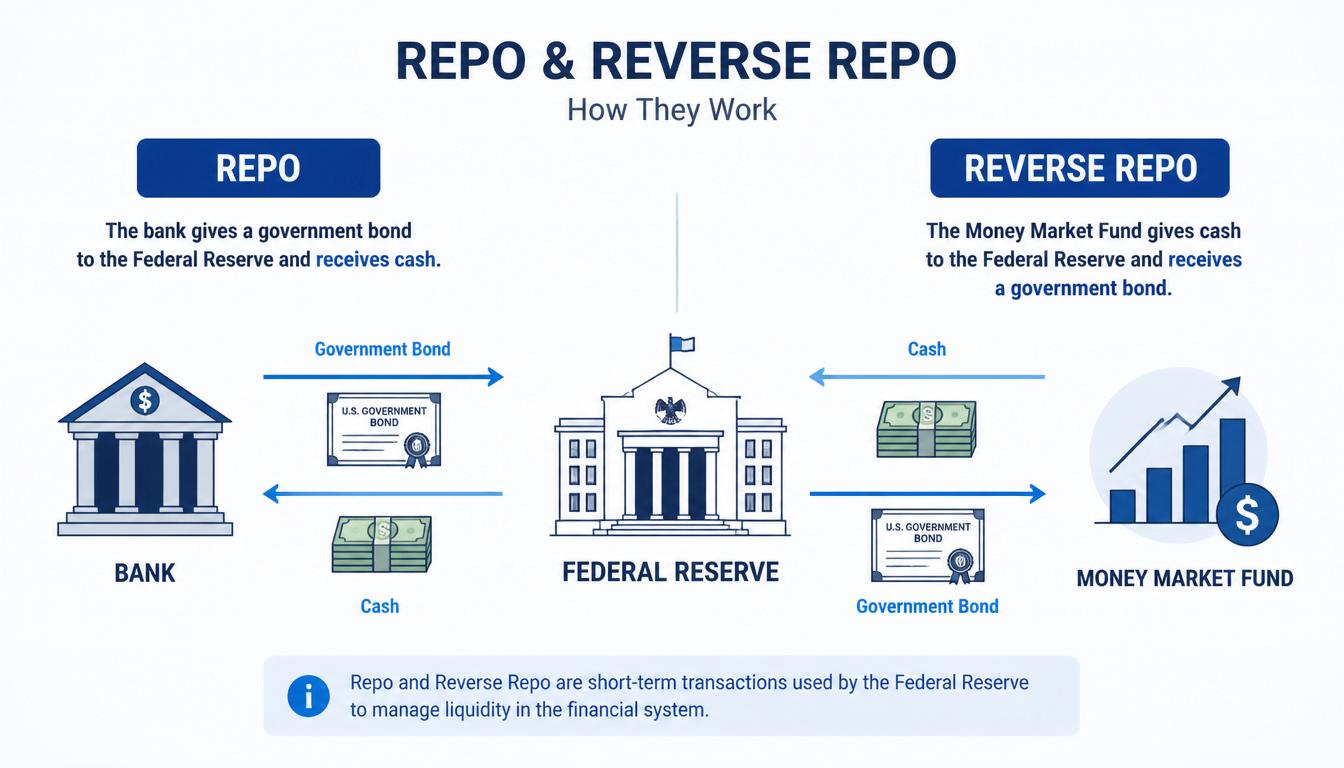
The term "Reverse Repo" often confuses retail investors. It is best understood by the participant's perspective:
- Repo (Borrowing Perspective): "I need cash now. Here is my Treasury bond as collateral—please lend me money." (The institution is borrowing).
- Reverse Repo (Lending Perspective): "I have excess cash. I will deposit it with the Fed, and in return, the Fed will provide Treasury securities as collateral." (The institution is lending to the Fed).
The Semantic Confusion: Why the dual naming? It all comes down to the Fed’s balance sheet. When the Fed borrows cash from institutional participants, it is a "Reverse" transaction from the perspective of the Fed’s traditional repo operations. For institutional giants, this is effectively the safest "overnight vault" in the global economy, offering risk-free yields guaranteed by the central bank.
3. Institutional Giants: Who Governs the Flow of Trillions?
This market is dominated by the titans of the Money Market Fund (MMF) industry. When market volatility surges, these institutions shift trillions into the RRP facility as a defensive posture.
| Rank | Institution | Key Strengths | Estimated AUM (Trillion USD) |
| 1 | BlackRock | Global market leader, vast MMF network | 10.0+ |
| 2 | Vanguard | Passive-heavy, stable institutional base | 8.0+ |
| 3 | Fidelity | Traditional MMF dominance | 5.0+ |
| 4 | JPMorgan AM | Institutional-grade short-term strategies | 3.0+ |
| 5 | State Street | Pension and institutional cash management | 3.0+ |
| 6 | Goldman Sachs | High-yield focus & expert trading | 2.5+ |
| 7 | Amundi | European powerhouse, global treasury | 2.0+ |
| 8 | BNY Mellon | Premier custodial & cash services | 2.0+ |
| 9 | DWS Group | German-backed stability | 1.0+ |
| 10 | Northern Trust | Bespoke institutional cash services | 1.0+ |
(Note: Data reflects general AUM standing. Specific fund liquidity varies by market conditions.)
4. Reading the Signal: Risk-On vs. Risk-Off
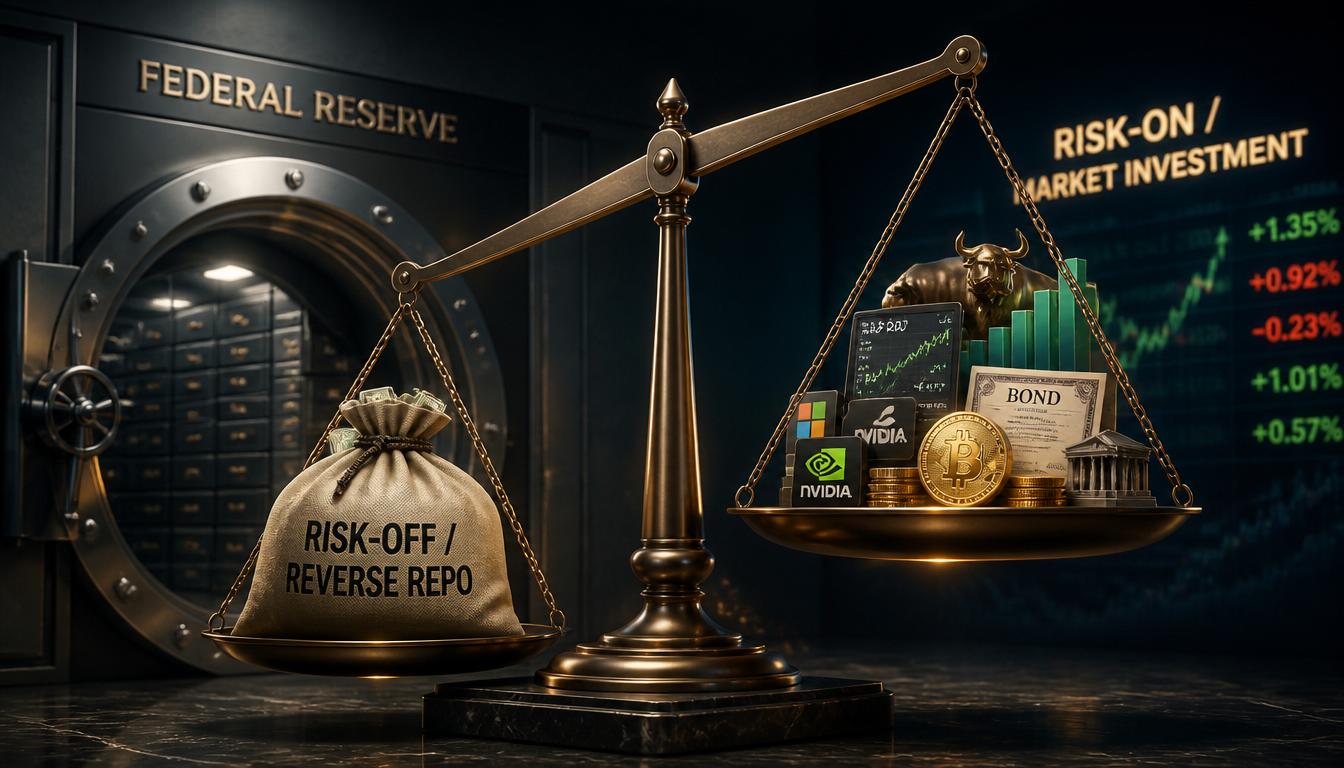
The RRP balance is effectively the market’s "Fear Gauge."
- The Risk-Off Signal: When the RRP balance trends upward, it indicates institutional fear. Capital is fleeing from volatile sectors—stocks and crypto—to hide in the safety of the Fed. It is a signal of liquidity contraction.
- The Risk-On Signal: When the balance trends toward zero, it reveals that institutional managers are no longer satisfied with the Fed’s risk-free rates. They are actively "hunting for yield." This excess liquidity is then redirected into productive assets, including AI infrastructure, corporate bonds, and digital assets.
5. The 2026 Landscape: The Signal is Green
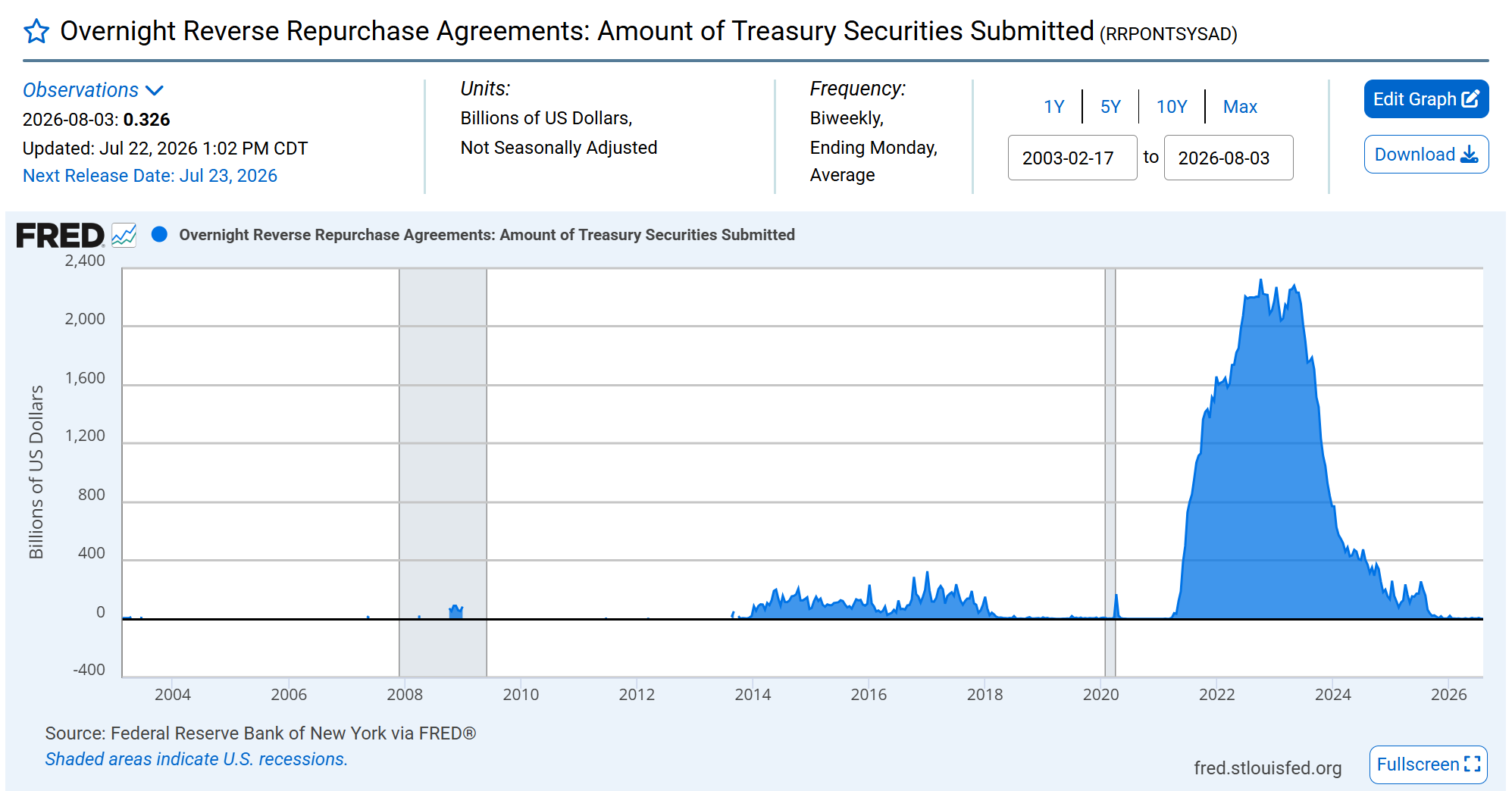
As of July 2026, the RRP balance is effectively hitting zero. This is a profound structural signal. Major institutions have essentially "unlocked" their capital, deeming the risk-free rate of the Fed inferior to potential market returns. This transition confirms that the systemic "Liquidity Party" for risk assets has begun in earnest.
- 2020-2021: Extreme risk-on, RRP at zero, massive asset inflation.
- 2022-2023: Historic tightening, RRP spiked to $2.5T, market capitulation.
- 2024-2025: Gradual RRP decline, AI revolution begins, market recovery.
- 2026 H2: AI concentration peak; we are now in the accumulation phase for the inevitable rotation into the crypto ecosystem.
Final Thoughts : Reading the Flow

The current consolidation in the crypto market is not a sign of stagnation—it is a classic accumulation phase preceding a capital rotation. We are tracking the velocity of money. As long as the Fed's RRP facility remains drained, the systemic liquidity for high-growth sectors remains primed and ready. For the disciplined investor, the question isn't whether the next wave is coming, but whether you are positioned before the rotation takes hold.
[Personal Reflection]
Having immersed myself in the crypto market for nearly a decade now, I’ve learned that the vast majority of that long journey consists of grueling bear markets, while major bull runs are agonizingly brief and intensely powerful. One of the core reasons why phased accumulation during a bear market is a sound strategy is precisely when the Fed's RRP balance is draining, while asset prices remain deeply undervalued relative to their fundamentals.
Conversely, when the RRP balance begins to rise, crypto asset prices skyrocket, and macro indicators like the Russell 2000 or the PMI race toward the peak of the cycle, we must keep firmly in mind that it is time to pivot to phased selling. I will organize these insights and share a dedicated post soon. Thank you for reading, and I hope you'll subscribe and drop by often!
[Deep Dive]
To gain a deeper understanding of the institutional shifts within tCryptocurrency Market and Traditional Financial Market, I highly recommend exploring my previous analyses.
Why Institutional Investors Are Looking Beyond Bitcoin: The Technological Backbone of Ripple (XRP)
Why Institutional Investors Are Looking Beyond Bitcoin: The Technological Backbone of Ripple (XRP)
The current global payment system is fundamentally broken. Trillions of dollars are trapped in the archaic "Nostro/Vostro" account structure, serving as a massive drag on global capital efficiency. Financial plumbing is being overhauled, and institutional
cryptoteslaglobal.com
SK Hynix on Nasdaq: The New Pillar of the Global AI Infrastructure
[Analysis] SK Hynix on Nasdaq : The New Pillar of the Global AI Infrastructure
1. Introduction: Understanding ADRs in the Age of AITo understand SK Hynix's listing on Nasdaq via American Depositary Receipts (ADRs), it is best to look at the mechanism that brought Bitcoin to the mainstream: the Spot ETF.Just as asset managers like Bla
cryptoteslaglobal.com
Bitcoin : The 'Digital Nuclear Weapon' - From the 1971 Nixon Shock to the Global Mining Arms Race
Bitcoin : The 'Digital Nuclear Weapon' - From the 1971 Nixon Shock to the Global Mining Arms Race
Do you still view Bitcoin merely as a "speculative asset"? If so, you are missing half the story. Since the 1971 Nixon Shock, when the Gold Standard was abandoned, fiat currency has rested on the fragile foundation of "government credit." As governments pr
cryptoteslaglobal.com