1. Introduction: Indices—The Mirror of Global Markets
Why You Should Stop Betting on Individual Stocks
If you spend your mornings obsessing over the volatile charts of single stocks, you are likely trapped in the "noise" of the market. Smart money—the institutional capital that moves the world—does not gamble on short-term price fluctuations of a single company. They bet on the direction of the economy.
The history of global finance is the history of the "Index." An index is not just a collection of tickers; it is a bio-sign of an economy’s health, an condensation of collective intelligence, and the most reliable mirror reflecting the pulse of global capital.

Why "Index" over "Individual"?
Many retail investors dream of finding the next "ten-bagger." While that is the allure of trading, the most resilient strategy in the capitalist system is owning the "market average."
- Risk Asymmetry: Individual companies can fail due to poor management or disruptive technology. However, an index maintains its vitality through "Automatic Rebalancing." It purges the weak and absorbs the strong, keeping the engine of growth running.
- Systemic Upward Trend: Indices are "living organisms." The S&P 500 has trended upward for nearly a century not because the companies inside it are fixed, but because it constantly evolves. By holding an index, you are effectively buying into the perpetual innovation of the global market.
What You Will Master
This guide is not a mere list of numbers. It is a financial navigator designed to answer:
- How does global capital form its massive waves?
- Why do institutions prioritize index derivatives over individual stocks for risk management?
- How can we capture opportunities at the intersection of traditional finance and the crypto ecosystem?
2. The 10 Hearts of the Global Market
Market indices are the "heartbeats" of the economy. Below are the 10 vital indices that every serious investor must monitor.
| Rank | Index Name | Character | Weighting | Rebalancing |
| 1 | S&P 500 | US Large-Cap | Market Cap | Quarterly |
| 2 | Nasdaq 100 | Tech Growth | Modified Cap | Annual |
| 3 | Dow Jones (DJIA) | US Blue-Chip | Price | Irregular |
| 4 | Russell 2000 | US Mid/Small-Cap | Market Cap | Annual |
| 5 | Euro Stoxx 50 | Eurozone Core | Market Cap | Quarterly |
| 6 | FTSE 100 | UK Large-Cap | Market Cap | Quarterly |
| 7 | Nikkei 225 | Japan Large-Cap | Price | Annual |
| 8 | Nifty 50 | India Growth | Market Cap | Semi-annual |
| 9 | SSE Composite | China Mainland | Market Cap | Irregular |
| 10 | Hang Seng (HSI) | Hong Kong Finance | Market Cap | Quarterly |
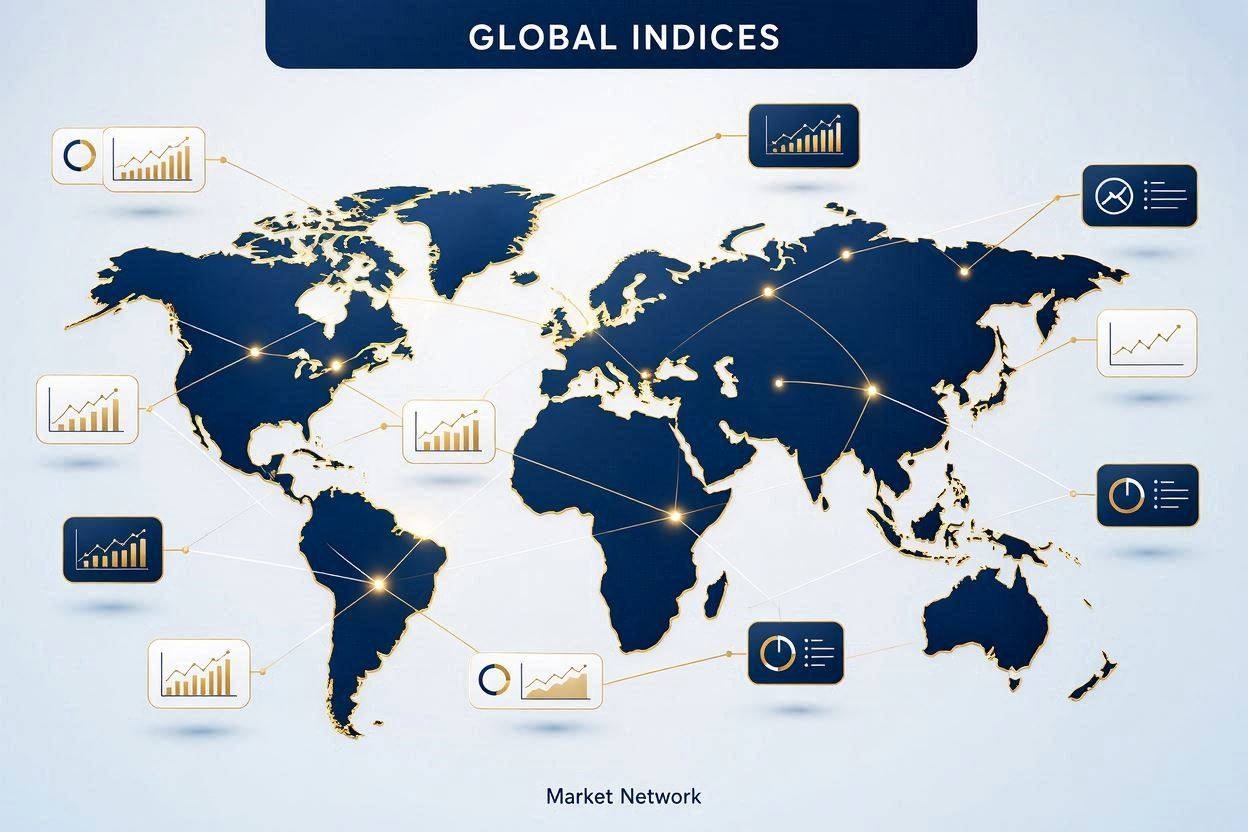
Key Market Insights: Understanding the VIX-Index Correlation
- S&P 500 (The Standard): The VIX acts as the market’s "Fear Gauge," measuring the cost of protective put options. Historically, the S&P 500 serves as the "safe harbor" for global institutional capital. When VIX spikes, capital often flees from speculative sectors into S&P 500 giants, making it the ultimate destination where liquidity settles once the dust of panic clears.
- Nasdaq 100 (The Innovation Engine): Because this index is dominated by high-growth tech firms, it is hyper-sensitive to "Growth Premiums." A rise in VIX directly impacts the discount rate applied to future earnings. Consequently, when VIX spikes, the Nasdaq 100 often undergoes the most violent price swings, as investors aggressively prune exposure to high-valuation growth assets.
- Dow Jones (The Defensive Shield): The DJIA’s composition—heavy on industrial giants, healthcare, and essential consumer staples—makes it the "old guard" of the market. Its price-weighted structure offers a unique cushioning effect; during VIX spikes, the Dow typically shows the most resilience, serving as a tactical defensive shield for portfolios that cannot afford high volatility.
- Russell 2000 (The Liquidity Amplifier): Small-cap firms lack the massive cash reserves of their large-cap counterparts. As such, the Russell 2000 is incredibly sensitive to liquidity conditions. Even a slight "tick" in the VIX can trigger a liquidity freeze in the small-cap sector, causing this index to act as a volatility amplifier, often dropping significantly faster than large-cap indices.
- Euro Stoxx 50 (The Regional Barometer): This index is the battleground for Eurozone economic health. When political instability or fiscal tension in Europe spikes the VIX, this index doesn't just reflect global fear; it reflects deep structural concerns regarding the currency union, often exhibiting deeper volatility than US-centric indices during localized European crises.
- FTSE 100 (The Commodity Hedge): The FTSE 100 is uniquely tied to global energy and raw material prices. When the VIX rises in tandem with commodity price volatility, the FTSE 100 can decouple from broad equity market trends. It serves as a sophisticated hedging tool for investors looking to balance their exposure against energy shocks.
- Nikkei 225 (The Carry-Trade Monitor): The Nikkei is the primary target for global Yen-denominated carry trades. Volatility here is frequently triggered by shifts in the USD/JPY exchange rate. When the VIX spikes, it often signals an unwind of these carry trades, leading to rapid capital flight from the Japanese market as global liquidity is sucked back to safer havens.
- Nifty 50 (The Growth Magnet): India’s economic narrative is driven by long-term demographic tailwinds. Interestingly, even during periods of extreme global VIX spikes, the Nifty 50 often acts as a "magnet for dip-buyers." Investors view temporary pullbacks in the Indian market as generational buying opportunities, leading to faster recoveries compared to other emerging market indices.
- SSE Composite (The Policy-Driven Trail): Unlike indices governed by market-wide fear, the SSE Composite is primarily steered by the central government’s monetary and fiscal mandates. It often ignores global VIX spikes, choosing instead to follow a unique trajectory dictated by internal policy, making it an excellent "non-correlated" asset for global diversification.
- Hang Seng (The Early Warning System): As the gateway between China and international capital, the Hang Seng acts as the "early warning system" for Asian capital markets. It reacts with hyper-sensitivity to geopolitical VIX spikes. When global sentiment sours, the Hang Seng is usually the first to signal a shift, making it a critical barometer for tracking institutional sentiment in Asia.
- Understanding an index is not just about its constituents; it is about knowing how it breathes when the market is under pressure. Below is a deep dive into the 10 vital indices and their structural relationship with the VIX.
3. The Magic Engine of Indices: How the Market Moves Itself
While the market may appear to be a chaotic series of waves, it operates on a precise "algorithmic necessity." Indices are not just static lists of numbers; they are the "engines" that drive trillions of dollars in automated capital. Let’s deconstruct how this machine works—from the perspective of a beginner, an intermediate investor, and a market pro.
[Beginner Level: The Giant Domino Effect - 'Passive Inflow']
Analogy: "The Index is a Buffet Plate." When you buy an S&P 500 ETF, you are buying the entire "buffet plate," which holds 500 of the finest companies. What happens when a company underperforms and is kicked off the plate, replaced by a promising newcomer?
- Mechanical Rebalancing: On the day index components change, trillions of dollars in passive funds "mechanically" sell the old and buy the new. This massive inflow of capital happens regardless of the company’s internal value—they buy simply because it has been "added to the index." This is the foundational profit engine of index investing.
[Intermediate Level: The Flow of Liquidity - 'Derivatives as the Hand']
Analogy: "The Index is the vessel, Derivatives are the hand that moves it." Let’s dig deeper. How do S&P 500 Futures and Options actually sway the market?
- Arbitrage: If index futures become more expensive than the underlying "basket" of stocks, institutions perform arbitrage—selling the futures and buying the physical stocks. This process instantly corrects market distortions.
- Liquidity Provision: Derivatives markets have far higher liquidity than spot markets. Instead of buying hundreds of individual stocks, institutions use a single index future contract to adjust their exposure to the entire market. A surge in index futures volume is the clearest signal that global capital is shifting.
[The Chain Reaction of Index Movements]
Market Events (News) → Algorithm Detection (Quant Analysis) → Derivatives Trading (Futures/Options) → Institutional Delta Hedging (Spot Buying/Selling) → Index Fluctuations → ETF Passive Fund RebalancingUnderstanding this mechanism allows you to see the "mathematical inevitability" hidden behind the noise of daily market fluctuations.
[Expert Level : The Invisible Hand - 'Delta Hedging']
Let’s face the truth. The market no longer reacts solely to human news. It reacts to algorithmic Delta values.
- The Reality of Delta Hedging : When an institution sells index options to a client, they must mechanically buy or sell the underlying index to offset their risk as the market moves. This is "Delta Hedging." During a market crash, the massive mechanical selling from these institutions isn't driven by "fear"—it's driven by a mathematical formula commanding them to "sell the spot." Algorithms, not human emotions, often trigger the extremes—either accelerating panic selling or creating a "Gamma Squeeze" to support the bottom.
- The Volatility Apex - 'Triple Witching Day' : Four times a year, the expiration of futures and options creates "Triple Witching Day." Trillions of dollars in Delta Hedging positions are liquidated or rolled over. The explosive trading volume and unpredictable volatility data on this day often mark the turning point for new trends. Experts watch the shift in positions on these days to forecast the market's trajectory for the coming month.
4. Index Derivatives : Risk Management or Amplification?
We have established that indices are not merely static numbers but complex "engines" fueled by algorithms and passive capital. The volatility generated within this engine is a source of terror for some, but a goldmine of opportunity for others.
"So, how do we use these derivatives to effectively manage our risk?"
Forget the misconception that derivatives are purely for gambling. For Wall Street giants, the essence of derivatives is not "profit maximization"—it is the "efficient transfer of risk."
[The Blueprint : Why Do These Instruments Exist?]
A derivative is a contract "derived" from the underlying index. Their fundamental purpose is to provide "liquidity" and "risk mitigation."
- Futures: Betting on Direction & Hedging
- Definition: A contract to buy or sell the index at a predetermined price on a future date.
- Purpose: To defend against a market-wide downturn without selling your spot holdings (Short Hedging), or to gain exposure to market growth with leverage (Long Position).
- Options: Asymmetric Risk Management
- Definition: A contract that gives you the right (but not the obligation) to buy (Call) or sell (Put) the index at a set price.
- Purpose: "Insurance." If you buy a Put option, your portfolio is protected even if the market collapses. This is the secret weapon institutions use to survive market crashes.
- VIX Derivatives: Trading the Fear Itself
- Definition: Instruments based on the VIX (Volatility Index).
- Purpose: When market fear hits its peak, VIX derivatives often soar in price, acting as the "ultimate safety valve" for a portfolio.
[Real-World Example : How Put Option Hedging Works]
Imagine you hold $100,000 worth of S&P 500 stocks at 5,000 points. The market looks great, but you fear a sudden correction. You purchase a small amount of 4,800-strike Put options as your "portfolio insurance." If the market suddenly crashes to 4,000 points, your stock value drops by $20,000, but your Put options skyrocket in value (potentially gaining $15,000+), offsetting most of the loss. You have essentially paid an "Option Premium" (the insurance fee) to protect the absolute value of your assets even in a market meltdown.

[The Crucial Question : Does Hedging Leave You with Nothing?]
Many beginners ask: "If I buy the index, short the futures, and buy put options, won't I end up at zero profit after fees?" The answer is: "Yes, and that is exactly the point of hedging."
- Analogy: "The Roof Repair Fund" You buy a house. If it doesn't rain, the roof stays fine and you don't need repairs. You pay monthly fire and home insurance premiums. If it doesn't rain, the premium simply vanishes—a cost to your assets. But when a "hurricane" hits and destroys the roof, the insurance payout covers the repair. Hedging is paying a premium to "purchase the survival of your assets" against the worst-case scenario.
- The Philosophy of Hedging:
- Directional Trading vs. Risk Management: Never confuse profit-seeking trades (directional) with asset-protecting trades (hedging).
- Rational Cost: We hedge not to grow wealth, but to prevent a level of loss that would ruin us.
- The Pro’s Choice: Professionals don't hedge everything. They apply "partial hedges" only when the probability of a market breakdown is high, or use options to lock in profits from a successful run.
Hedging is not a "negative" cost; it is a "fixed expense" paid to protect yourself from unpredictable volatility. Once you stop viewing this as a loss, you have evolved from a "Speculator" to an "Asset Manager."
5. The Rise of Crypto Indices : Imposing Order on the Digital Frontier
Traditional financial logic is being transplanted into the massive laboratory of digital assets. The Crypto market has graduated from its early "wild west" phase, and as institutional capital floods in, index products are proving the asset class's maturity.
[Why Do We Need Crypto Indices?]
The era of obsessing over individual Bitcoin or Ethereum prices is fading. Now, smart money asks: "What is the health of the entire crypto market?"
- Market Vital Signs: Index products now measure the "Inflow Strength" of the entire market, going far beyond simple "Bitcoin Dominance."
- The Gate to Institutionalization: The approval of Spot ETFs by firms like BlackRock is the ultimate proof that Crypto is now an "Asset Class" predictable enough to be included in pension fund portfolios.
[The Logic Transplant: Types of Crypto Indices]
- Market Benchmarks: CoinDesk 20, Bloomberg Crypto Index. These show the aggregate direction of the entire market, much like the S&P 500.
- Thematic Indices: DeFi Index, Layer 1 Index, AI Crypto Index. These allow for "sector investing," mirroring traditional finance.
- Volatility Indices: DVOL (Deribit Volatility Index). Used by institutions to quantify market "Fear and Greed," serving as a benchmark for risk management.
[The Expert View: Correlation and Independence]
In the past, Crypto moved in lockstep with Tech stocks (Nasdaq). However, as indexing deepens, we see a shift: Crypto is emerging as an independent Asset Class. Investors are no longer looking just at Bitcoin prices; they are looking at "Crypto Index trends." This implies that you can soon use Crypto indices as a "Hedging tool" to protect your traditional stock portfolios. The logic of the "Put Option Hedge" you learned in Step 4 is now becoming applicable to the digital frontier.
[Conclusion: An Index is Not Just a Number; It’s Your Philosophy]
We have deconstructed the engine of global markets. Why study indices? Because individual stock noise narrows your vision, but indices expand your view to the entire "forest." An index is not just a digit to follow; it is a "Real-time Management Report" that visualizes the heartbeat of capitalism.
The index is no longer a number you watch from the outside. It is an engine that you interpret, participate in, and—at times—harness through derivatives to make volatility work for you. Open your charts. Check the volume. Feel the speed of the engine. That is the first step of your journey on the massive waves of global finance.
[Personal Reflection]
Years ago, I actually traded index derivatives myself. They are perilous instruments that force you to endure extreme volatility driven by leverage. Back then, I didn't truly understand what an index was or how its mechanics worked; I simply focused on the numbers ticking up and down, trying to survive through scalping.
However, after stepping into the crypto market and navigating cycle investing, I finally learned to see the big picture—how to look at the "forest" rather than just the trees, understanding what an index truly represents as a macro framework. That realization inspired me to capture these insights in writing. Moving forward, I will continue sharing valuable stories infused with my own unique perspective and narrative. Thank you for reading, and I hope you'll subscribe and drop by often!
[Deep Dive]
To gain a deeper understanding of the institutional shifts within the crypto market, I highly recommend exploring my previous analyses.
Why Institutional Investors Are Looking Beyond Bitcoin: The Technological Backbone of Ripple (XRP)
Why Institutional Investors Are Looking Beyond Bitcoin: The Technological Backbone of Ripple (XRP)
The current global payment system is fundamentally broken. Trillions of dollars are trapped in the archaic "Nostro/Vostro" account structure, serving as a massive drag on global capital efficiency. Financial plumbing is being overhauled, and institutional
cryptoteslaglobal.com
Ethereum : The Operating System for the New Digital Finance
Ethereum : The Operating System for the New Digital Finance
Why Wall Street is Obsessed with the "World Computer" (2026 Updated)"This is not just another cryptocurrency. It is the operating system (OS) for the new digital economy."While Bitcoin acts as 'digital gold'—a store of value—Ethereum is the 'World Comp
cryptoteslaglobal.com
Bitcoin : The 'Digital Nuclear Weapon' - From the 1971 Nixon Shock to the Global Mining Arms Race
Bitcoin : The 'Digital Nuclear Weapon' - From the 1971 Nixon Shock to the Global Mining Arms Race
Do you still view Bitcoin merely as a "speculative asset"? If so, you are missing half the story. Since the 1971 Nixon Shock, when the Gold Standard was abandoned, fiat currency has rested on the fragile foundation of "government credit." As governments pr
cryptoteslaglobal.com