The Emperor of Wall Street is dancing on the blockchain.
Why is JPMorgan, a vocal critic of Bitcoin, secretly betting on Solana? The answer lies in the shift toward institutional-grade infrastructure.
The greatest irony in modern finance is currently unfolding. JPMorgan, the bank that has spent years relentlessly bashing Bitcoin as a "fraud," has just issued real commercial paper (USCP) on a public blockchain: Solana. This isn't a pilot program or a sandbox experiment; they’ve partnered with Coinbase and Franklin Templeton to settle actual financial instruments on-chain. While they publicly preach that crypto is "dangerous," they are quietly and aggressively absorbing the efficiency of blockchain infrastructure.

1. The History of JPMorgan: Foundation, Mergers, and the Breakup with Morgan Stanley
The history of JPMorgan is, in many ways, the history of Wall Street itself.
- Origin and Growth: Tracing its roots back to the 1799 "Manhattan Company" and John Pierpont Morgan’s 1871 firm, "Drexel, Morgan & Co.," the bank dominated the U.S. railroad and steel industries in the early 20th century, effectively serving as the nation's central bank.
- The Split with Morgan Stanley: The 1933 Glass-Steagall Act was the pivotal turning point. This law forced a strict separation between commercial banking (deposits/loans) and investment banking (securities/IB). Consequently, JPMorgan’s empire was bifurcated, and its investment banking arm spun off to become what we know today as Morgan Stanley.
- The Modern Era: With the de facto repeal of Glass-Steagall in 1999, JPMorgan integrated Chase Manhattan, Bank One, and others to become the modern financial behemoth: JPMorgan Chase & Co. Today, it stands at the pinnacle of "universal banking," performing both commercial and investment functions.
[JPMorgan’s Organizational Structure: The Four Pillars of Capital Flow]
| Business Division | Primary Role | Blockchain/Crypto Relevance |
| Consumer & Community Banking (CCB) | Retail deposits, loans, and card services | Revolutionizing retail payment services |
| Corporate & Investment Bank (CIB) | Corporate finance, M&A, trading | Core. Tokenization of commercial paper, bonds, and derivatives |
| Commercial Banking | Financial solutions for mid-sized firms | Adoption of tokenized deposit systems |
| Asset & Wealth Management (AWM) | Asset management for HNWIs and institutions | Tokenized fund products like BUIDL |
- Kinexys (formerly Onyx): Operating under the CIB division, this innovation hub utilizes blockchain (Solana, Ethereum, etc.) as the "back-end rail" to reduce latency and friction in massive capital movements.
Historical Insight: The "breakup with Morgan Stanley" explains why JPMorgan is so intent on building its own blockchain infrastructure. Where the law once forced the bank to split, technology is now allowing the bank to absorb the entirety of the financial process.
2. "Bitcoin is a Fraud": Jamie Dimon’s Decade of Vitriol
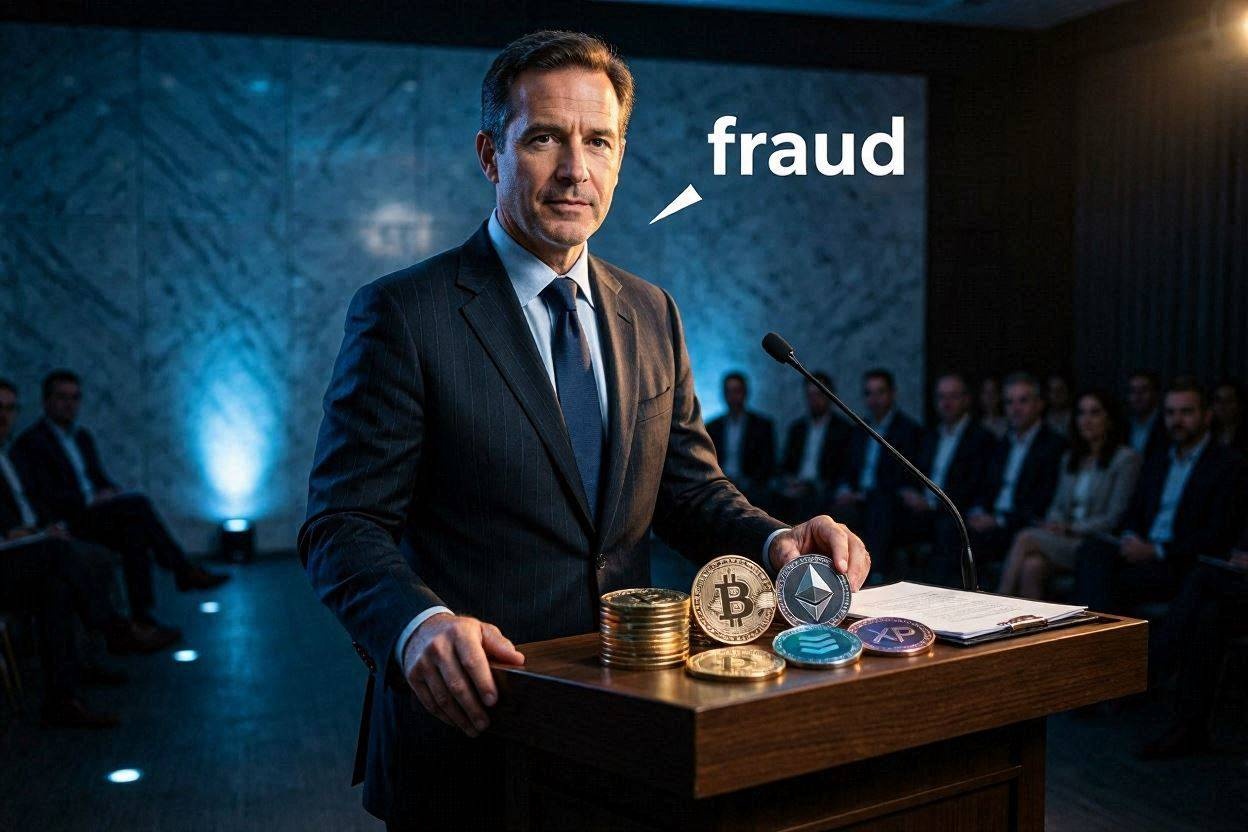
Jamie Dimon, the face of JPMorgan, has been the most vocal "crypto-skeptic" in the financial world for over a decade. His words are not just personal opinions; they are "verbal bombs" that move global markets.
- 2017: The "Fraud" Bomb
- The Stance: "Bitcoin is a fraud. It’s worse than the tulip bulbs in the 17th century."
- The Threat: He threatened to fire any employee trading Bitcoin for being "stupid."
- 2018: "Regret," but No Change in Heart
- He walked back the "fraud" comment slightly, but firmly drew a line: "I believe in blockchain technology, but have no interest in Bitcoin itself."
- 2023: Branding it a "Criminal’s Tool"
- In a Senate Banking Committee hearing, he claimed, "The only true use case for Bitcoin is criminals, drug traffickers, money launderers, and tax evaders." The crypto community retorted, citing JPMorgan’s own long history of regulatory fines and legal controversies.
- 2024–2025: "Pet Rocks" and Capitulation
- He labeled Bitcoin a "pet rock." However, eventually yielding to market pressure, he conceded: "I don't like Bitcoin, but if a client wants to buy it, I won't stop them."
Curious about what they are doing behind closed doors? Check this out:
https://news.bitcoin.com/jpmorgan-hits-landmark-breakthrough-using-public-blockchain-rails/
JPMorgan Hits Landmark Breakthrough Using Public Blockchain Rails
JPMorgan hit a landmark breakthrough by issuing Galaxy’s commercial paper on Solana, with Coinbase and Franklin Templeton participating, signaling accelerating institutional momentum toward programmable, transparent on-chain rails reshaping how real fina
news.bitcoin.com
3. JPMorgan and Washington : Who Dances with the Power of Finance?

JPMorgan is more than a bank; it is deeply entrenched in the U.S. political sphere.
- Dimon’s Politics : Dimon considers himself a "barely a Democrat" but prioritizes "pro-business, pro-market, and efficient government" policies above ideology.
- The "Debanking" Controversy : Whether it's the 2021 closure of Donald Trump’s accounts or other political figures, JPMorgan maintains that these decisions are based on "risk management," not political vendettas.
- The Nature of Financial Power : People often ask, "Is JPMorgan on the side of the Democrats or the Republicans?" That question is a trap. To JPMorgan, political affiliations are mere tools—the Democrats are a "tether" to navigate regulations, and the Republicans are a "sail" for expansion.
What they truly seek to protect is the power of the "financial system" itself. Dimon’s attacks on Bitcoin are not mere prejudice; they are a defensive mechanism against the "decentralization" that threatens their monopoly. Bitcoin isn't attacked because it's a "fraud"; it's attacked because it threatens their throne.
4. JPMorgan’s Crypto Business : "Discarding the Words, Absorbing the Infrastructure"
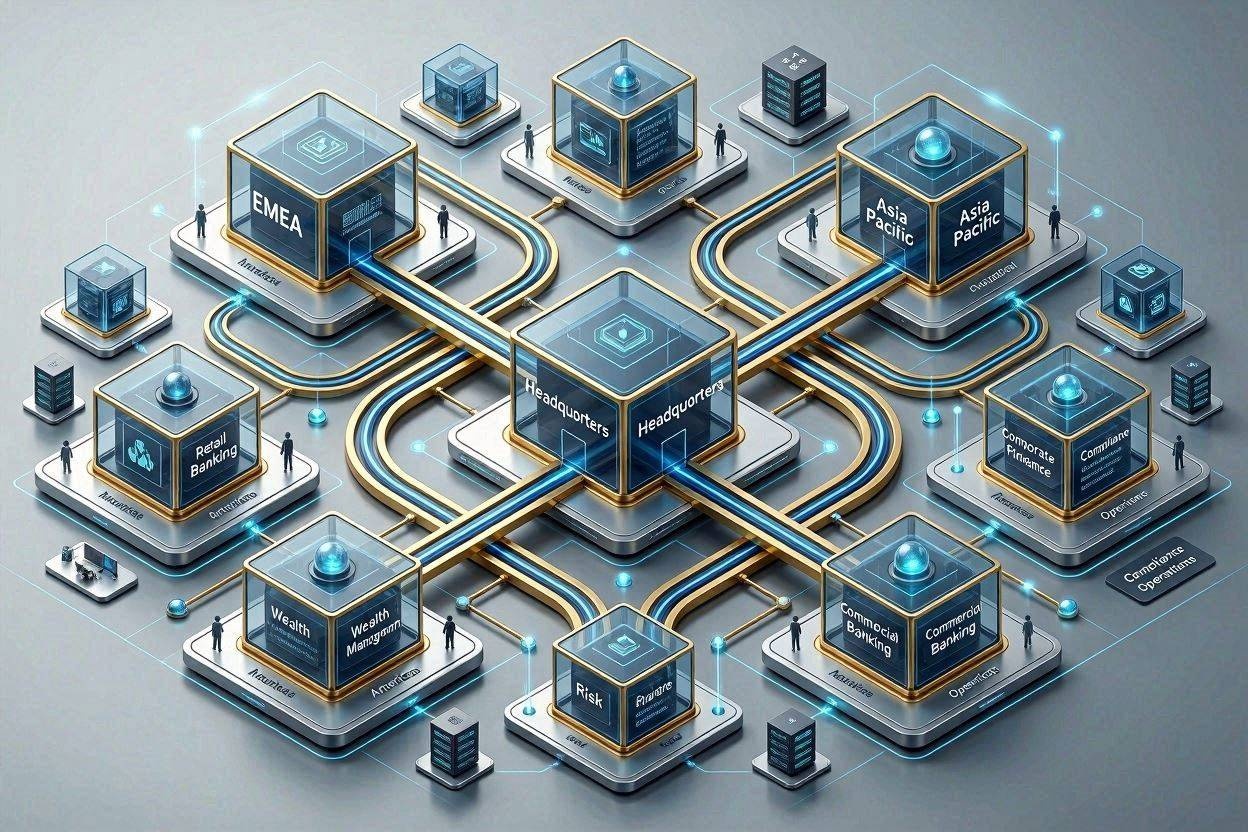
JPMorgan’s massive financial architecture and its digital settlement rails
While JPMorgan outwardly dismisses Bitcoin as a "fraud," it is internally building a massive blockchain ecosystem called "Kinexys," which is already processing trillions of dollars. What they are building is not a decentralized "cryptocurrency," but rather a "controllable digital financial infrastructure."
1) Kinexys : The Blockchain Command Center of Wall Street
Kinexys is the integrated platform for all of JPMorgan’s blockchain-based financial solutions (formerly known as Onyx).
- Objective: It aims to solve the chronic issues of traditional finance—namely, "slow settlement" and "complex intermediary processes"—through blockchain-powered "Programmable Payments."
- Core Strength: It supports 24/7 real-time settlement, allowing corporations to slash settlement times from days to mere seconds. As of 2025, it is a battle-tested infrastructure with daily transaction volumes exceeding $5 billion.
2) JPM Coin : The "Digital Deposit Token" Guaranteed by the Bank
JPM Coin is fundamentally different from the highly volatile cryptocurrencies that typically come to mind.
- Operating Principle : It is a "Deposit Token" that is pegged 1:1 to the U.S. dollars held by customers on deposit at JPMorgan.
- Key Differentiator : Unlike stablecoins (like USDT) that often face scrutiny regarding the transparency of their collateral assets, JPM Coin is a digital version of "actual deposits" operating within the bank's legal protective net. In short, it is the digital version of the U.S. dollar, backed and guaranteed by a banking giant like JPMorgan.
- Usage : Access is strictly limited to large corporations, financial institutions, and broker-dealers who have passed JPMorgan’s rigorous vetting process.
3) Why are they obsessed with "Private" chains?
JPMorgan’s preference for building its own closed-off network (Permissioned Blockchain) over public chains (like Bitcoin) comes down to clear motives:
- Privacy and Regulation : Public blockchains, where all transaction history is transparently visible, cannot protect a corporation's trade secrets. Kinexys allows for fine-tuned permissions, ensuring that only authorized participants can view specific data.
- Legal Accountability : In the event of a financial incident, there must be a clear "legal framework for accountability." This level of oversight is only possible within an infrastructure controlled by the bank.
5. Investor Perspective : Listen to the "Words," or Follow the "Actions"?

It is time to stop listening to their "rhetoric" and start following the "movement" of their capital.
Many investors react emotionally to Jamie Dimon's harsh critiques or the FUD (Fear, Uncertainty, and Doubt) that frequently hits the news cycle. However, true professionals don't listen to what is being said—they watch where the capital is moving.
1) "Words" are Marketing, "Actions" are Strategy
- The Words (FUD): Jamie Dimon’s public criticism of Bitcoin is a calculated political maneuver. It is designed to reassure JPMorgan’s conservative institutional clients and prevent capital flight from traditional assets into the public crypto markets they cannot yet fully control.
- The Actions (Rails): Conversely, when JPMorgan issues commercial paper on Solana or builds real-time settlement rails through Kinexys, they are signaling that they have fully embraced blockchain "efficiency" as a core pillar of their business model.
2) The "Slow-Burn" Bull Case
JPMorgan’s choice to leverage Solana is a powerful testament that this network has become a vital piece of infrastructure for global institutions to conduct business.
- "Too Big to Fail" : Once a financial titan like JPMorgan adopts a public blockchain for settlement, that network is effectively woven into the fabric of the global financial system. This represents a fundamental revaluation of the network’s utility that far transcends temporary price pumps.
- Keep Things Separate : JPMorgan using Solana does not mean the price of SOL will skyrocket tomorrow. However, it does mean that an infrastructure increasingly relied upon by global financial institutions will inevitably secure the most robust security budgets and long-term ecosystem development.
3) Conclusion : Follow the Footprints of the Giants
While the "big players" in the market are busy calling Bitcoin a "fraud," they are quietly moving to monopolize the underlying blockchain infrastructure.
- Our Stance : Do not let their rhetoric shake your conviction or cause you to dump your assets. Instead, track their "actions": observe which networks they adopt, which protocols they utilize, and how they allocate their capital.
"The Emperor of Wall Street may use his words to reject Bitcoin, but through his actions, he is conquering the blockchain. It is time for us to study the map of the digital financial empire they are building—and position ourselves at the very start of the flow."
Therefore, whenever I analyze the market, I make it a point to watch what financial giants do, not what they say. It is crucial to carefully examine media reports and build the habit of distinguishing whether a news story is backed by concrete actions or is merely speculation wrapped in rhetoric.
[Deep Dive]
To gain a deeper understanding of the institutional shifts within the crypto market, I highly recommend exploring my previous analyses.
Why Institutional Investors Are Looking Beyond Bitcoin: The Technological Backbone of Ripple (XRP)
Why Institutional Investors Are Looking Beyond Bitcoin: The Technological Backbone of Ripple (XRP)
The current global payment system is fundamentally broken. Trillions of dollars are trapped in the archaic "Nostro/Vostro" account structure, serving as a massive drag on global capital efficiency. Financial plumbing is being overhauled, and institutional
cryptoteslaglobal.com
Ethereum : The Operating System for the New Digital Finance
Ethereum : The Operating System for the New Digital Finance
Why Wall Street is Obsessed with the "World Computer" (2026 Updated)"This is not just another cryptocurrency. It is the operating system (OS) for the new digital economy."While Bitcoin acts as 'digital gold'—a store of value—Ethereum is the 'World Comp
cryptoteslaglobal.com
The Ultimate Guide to Solana (SOL): From the FTX Crash to Liquid Staking and $3,000 Price Predictions
From being pronounced "dead" during the FTX collapse to hitting new all-time highs in 2025, Solana’s resilience is unmatched. Discover the architectural secrets that make it the ultimate "Ethereum Killer," how global giants like Visa are utilizing its ne
cryptoteslaglobal.com
Clearstream’s Crypto Expansion : Why Institutional Giants Are Turning XRP and SOL into Global Financial Infrastructure
"With Spot Bitcoin ETFs now a market staple, Wall Street’s focus has aggressively shifted toward the next major bottleneck: Secure Digital Asset Custody. Deutsche Börse’s Clearstream has quietly expanded its custody services to include XRP, SOL, ADA,
cryptoteslaglobal.com