Why Wall Street is Obsessed with the "World Computer" (2026 Updated)
"This is not just another cryptocurrency. It is the operating system (OS) for the new digital economy."
While Bitcoin acts as 'digital gold'—a store of value—Ethereum is the 'World Computer,' the foundational layer upon which infrastructure is built. From Decentralized Finance (DeFi) and NFTs to the Real-World Assets (RWA) now capturing the attention of major Wall Street institutions, Ethereum sits at the epicenter of this financial revolution. This guide will provide you with a comprehensive understanding of Ethereum’s essence.
1. The Origin : Vitalik Buterin’s Vision and the Birth of the World Computer

TL;DR
- 2013 : Vitalik Buterin conceptualized a programmable blockchain to overcome the limitations of Bitcoin.
- The World Computer : Ethereum provides a universal platform enabling anyone to build and deploy Decentralized Applications (DApps).
- Status Quo : Since its launch in 2015, Ethereum has evolved into the central hub of global financial and technological innovation.
While Bitcoin was engineered primarily for value transfer, a 19-year-old prodigy, Vitalik Buterin, envisioned a 'universal platform' capable of executing any logic on the blockchain. He recognized that the true power of blockchain lay not just in exchanging currency, but in the ability to execute agreements through code—the birth of Smart Contracts. With the official launch of the Ethereum network in 2015, the era of the 'World Computer' began, empowering developers worldwide to deploy their own applications onto a decentralized infrastructure.
2. Smart Contracts : From Concepts to Real-World Application

TL;DR
- Definition : Smart contracts are digital agreements that execute automatically when predefined conditions are met, eliminating the need for intermediaries.
- Simple Analogy : Think of a 'vending machine'—input a specific logic, and you get a guaranteed result.
- Technical Depth : Built on a Turing-complete language called Solidity, these contracts enable complex financial logic on-chain.
Smart contracts replace third-party trust (banks, lawyers, etc.) with code-based guarantees. Running on the Ethereum Virtual Machine (EVM), Solidity offers limitless scalability, laying the groundwork for the entire DeFi ecosystem we see today.
Real-World Use Cases of Smart Contracts
Beyond simple automation, smart contracts act as the engine that reduces 'trust costs' to zero across industries.
| Sector | Primary Use Case | Key Benefits |
| Finance / Asset Management | Securities lending, cross-border remittance | Faster settlement, lower intermediation costs |
| Logistics / Supply Chain | Supply chain tracking, condition monitoring | Real-time transparency, tamper-proof records |
| Real Estate | Automated lease agreements, smart locks | Intermediary-free automated rental systems |
| P2P Transactions | Escrow services | Fraud prevention, secure peer-to-peer trade |
| Content / IP | Automated royalty distribution | Maximum transparency, copyright protection |
3. ERC-20 : The Common Language of the Ethereum Ecosystem
TL;DR
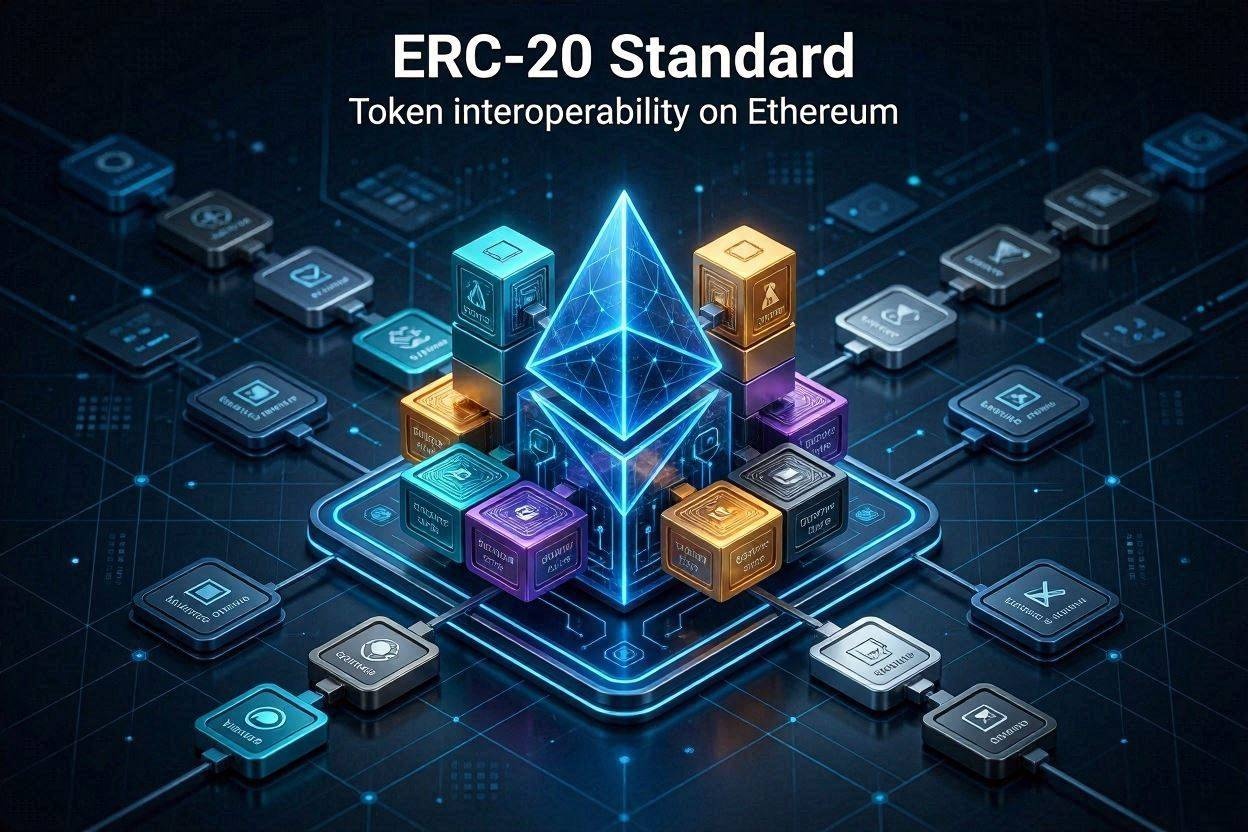
- Definition: ERC-20 is the technical standard for creating 'fungible' tokens on the Ethereum network.
- Compatibility: It allows wallets and exchanges to process thousands of different tokens using a unified set of rules.
- Nature: Tokens exist as records within Ethereum contracts, rather than on separate blockchains.
Why Does Ethereum Command Superior Liquidity?
ERC-20 is more than just a set of rules; it is an architectural milestone that established interoperability within the Ethereum financial platform.
- Composable Finance ("Money Lego") : Before ERC-20, developers had to create custom protocols for every new token. By standardizing essential functions—totalSupply, balanceOf, and transfer—ERC-20 enabled any DeFi protocol to immediately swap or collateralize any token. This sparked the "Money Lego" phenomenon, where financial services can be assembled effortlessly.
- Standardizing Infrastructure : For professional investors and exchanges, ERC-20 reduces infrastructure costs significantly. As long as a token adheres to the ERC-20 standard, exchanges can support it instantly without complex technical integration. This concentrates global liquidity, preventing ecosystem fragmentation.
- Evolution and Challenges : While ERC-20 has technical vulnerabilities—such as the inability to communicate with contracts during token transfers—its network effect is insurmountable. Despite newer proposals like ERC-223 or ERC-777, ERC-20 remains the industry's de facto standard because the vast majority of global liquidity is already locked within this architecture.
4. The Merge : The Great Transition from PoW to PoS

TL;DR
- The Shift : Ethereum transitioned from Proof-of-Work (PoW) to Proof-of-Stake (PoS) to solve high energy consumption.
- Efficiency : The 2022 "Merge" reduced Ethereum’s energy consumption by over 99.9%.
- Security : The network is now secured through staking, where validators earn rewards for securing the chain.
"The Merge" was more than just a software update; it was a fundamental redesign of Ethereum’s economic protocol into a capital-based system.
- Technological Leap : While PoW relied on physical hardware (hash power), PoS utilizes staked ETH as collateral. This 99.9% reduction in energy usage made Ethereum an ESG-compliant asset, opening the gates for institutional investors.
- Economic Impact (Ultra Sound Money) : With the removal of block rewards for miners and the integration of the EIP-1559 "burn" mechanism, ETH has evolved into a deflationary asset. As demand from Smart Contracts and RWA grows against a shrinking supply, Ethereum is increasingly viewed by Wall Street as "digital bonds" or "Ultra Sound Money."
- A Masterclass in Execution : Upgrading a network with hundreds of billions of dollars in assets while it is running is like "changing the engine of a plane in mid-flight." The flawless execution after seven years of testing cemented Ethereum’s reputation as a robust financial infrastructure.
[Comparison: Proof-of-Work (PoW) vs. Proof-of-Stake (PoS)]
| Comparison Criteria | Proof-of-Work (PoW - Past) | Proof-of-Stake (PoS - Present) |
| Consensus Mechanism | Hardware computing power (Mining) | Capital staking (Staking) |
| Energy Efficiency | Very Low (High power consumption) | Very High (99.9% improvement) |
| Security Basis | Hash power (Electricity & Machine) | Staked ETH (Asset value) |
| Inflationary Model | Supply increase via mining rewards | Potential deflation via supply reduction/burn |
| Main Criticism | Environmental impact, mining centralization | Risk of capital concentration (Wealth gap) |
As shown above, Ethereum has evolved from a simple coin-mining network into a massive, capital-staked financial infrastructure.
5. Economic Ecosystem : Transaction Dynamics and the Secret of Gas Fees
TL;DR
- Gas Fees : Payments for the computational resources required to maintain the Ethereum network.
- Burn Mechanism : EIP-1559 ensures that a portion of gas fees is permanently destroyed (burned) with every transaction.
- Deflationary Engine : As network activity increases, ETH supply decreases, creating a powerful economic virtuous cycle.
The core of Ethereum’s economic model lies in the relationship between network utility and asset scarcity.
- Gas as a Resource Distributor : Ethereum is a "World Computer" with finite resources. Gas fees act as a market-driven pricing system to prioritize high-value transactions and prevent network spam.
- EIP-1559 & The Burn : By burning the "Base Fee," Ethereum creates a supply-demand loop where network activity directly correlates with asset appreciation.
- Institutional Perspective : Institutional investors analyze the "burn rate" similar to corporate stock buybacks or dividends. Ethereum is perceived not just as a platform, but as infrastructure that generates value and defends asset scarcity.
The Evolution of Ethereum Gas Fees
Ethereum gas fees are the "fuel costs" paid to perform computations on the network. However, this mechanism underwent a revolutionary change in August 2021 with the EIP-1559 update, introduced during the 'London Hard Fork.'
Gas Fee Volatility Structure
Gas fees are dynamically adjusted by 12.5% per block based on network transaction density. This volatility serves as a critical filtering mechanism to prevent network overload: when demand spikes, fees surge; during quiet periods, they plummet.
Estimated Transaction Cost Scale
Transaction costs vary based on the complexity (computational load) of the task. Below is the average gas fee ratio relative to the transaction amount:
| Transaction Type | Avg. Gas Fee (%) | Key Characteristics |
| Simple ETH Transfer | 0.05% ~ 0.1% | Low computation, cost-efficient |
| Token Swap (DEX) | 0.5% ~ 2.0% | Proportional to smart contract complexity |
| NFT Minting/Trading | 1.0% ~ 5.0% | High fees due to complex data storage |
| Complex DeFi Staking | 2.0% ~ 10.0% | High cost due to multiple function calls |
Note: These figures fluctuate based on network congestion. Using Layer 2 solutions can reduce these costs by over 99%.
6. Scaling Solutions : The Rise of Layer 2 (L2)
While the Ethereum Mainnet (L1) provides unparalleled security, it faces a chronic "scalability challenge" where transaction fees spike during periods of high congestion. Layer 2 solutions resolve this by processing transactions off-chain and submitting only the final result to L1, revolutionizing both speed and cost efficiency.
Comparison of Leading Layer 2 Solutions
| Criteria | Polygon (POL) | Arbitrum (ARB) | Optimism (OP) | Base (BASE) |
| Launch Year | 2017 | 2021 | 2021 | 2023 |
| Founder/Entity | Sandeep Nailwal et al. | Offchain Labs | Optimism PBC | Coinbase |
| Core Concept | Sidechain/ZK | Optimistic Rollup | Optimistic Rollup | OP Stack/L2 |
Analysis of Leading L2 Ecosystems
① Polygon (POL, formerly MATIC)
- Concept : A multi-chain platform designed to solve Ethereum’s persistent fee issues. With the transition to "Polygon 2.0," it has restructured its economic model around the POL token.
- Use Case : Beyond DeFi, it is actively utilized by global brands like Starbucks and Nike for NFT-based loyalty programs and RWA tokenization projects
② Arbitrum (ARB)
- Concept : A leader in "Optimistic Rollup" technology, boasting near-perfect compatibility with the Ethereum Virtual Machine (EVM).
- Use Case : The hub of the Ethereum DeFi ecosystem. It hosts high-performance financial applications like GMX (decentralized perpetual exchange) and sees significant volume in stablecoin settlements and liquidity provisioning.
③ Optimism (OP)
- Concept : Empowering developers through the developer-friendly "OP Stack," allowing anyone to launch their own Layer 2. It aims to build a unified "Superchain" ecosystem.
- Use Case : Leads the way in public goods funding through the "Optimism Collective" governance model. It maintains a powerful community presence in DeFi and on-chain gaming.
④ Base (BASE)
- Concept : An L2 developed directly by Coinbase, the world’s largest crypto exchange, leveraging its massive existing user base.
- Use Case : Deeply integrated with Coinbase's traditional financial services. It is rapidly expanding the stablecoin payment ecosystem and serves as a primary gateway for on-chain social apps and RWA financial products.
7. Ethereum Roadmap : The Path to the "World Computer"
Ethereum is evolving step-by-step according to the long-term roadmap outlined by Vitalik Buterin. While the initial focus was on network stability, the current priority has shifted to achieving "Scalability" for high-volume transactions while strictly maintaining "Decentralization."
Ethereum Roadmap Milestones
| Stage | Name | Core Objective | Status |
| Past | Frontier | Initial launch and network setup | Completed |
| Past | The Merge | Transition from PoW to PoS (Energy efficiency) | Completed |
| Present | The Surge | Maximizing scalability via Rollup technology | In Progress |
| Future | The Scourge | Mitigating MEV risks & enhancing censorship resistance | Planned |
| Future | The Verge | Improving verification via Merkle Tree optimization | Planned |
| Future | The Purge | Network optimization by clearing unnecessary data | Planned |
| Future | The Splurge | Finalizing the synchronization of all previous stages | Planned |
Key Takeaways : Why the Roadmap Matters
- The Completion of The Merge : By reducing energy consumption by 99.9%, Ethereum has established the "legitimate" foundation required by Wall Street institutions that prioritize ESG compliance.
- The Surge (Current Focus) : This phase is pivotal, as it enables Layer 2 solutions to record data on Ethereum more affordably. Success here is the key to Ethereum becoming a true "World Computer" capable of processing tens of thousands of transactions per second.
- Censorship Resistance & The Future : Subsequent stages like The Scourge and The Verge ensure that Ethereum remains decentralized, technically guaranteeing that no single entity can manipulate or censor the network.
Insights for the Global Investor
By analyzing this roadmap, it becomes clear that Ethereum’s upgrades are not aimed at short-term price manipulation. Rather, the network is systematically solving the fundamental challenge of building a global, secure, and lightning-fast financial network. As this roadmap unfolds, Ethereum’s intrinsic value will be further solidified in the global market.
8. The RWA Revolution : Why Wall Street is Buying In
TL;DR
- The Paradigm Shift : Real-World Assets (RWA) represent the revolutionary process of bringing real-world value—such as real estate, bonds, and fine art—onto the blockchain.
- The Standard : Thanks to its robust security and superior interoperability, Ethereum has become the chosen global financial standard for RWA tokenization.
- Institutional Integration : Global asset managers, including BlackRock, are leveraging Ethereum-based tokenized funds to build a bridge between traditional finance (TradFi) and decentralized finance (DeFi).
For years, digital assets existed in a self-contained ecosystem. Today, we are witnessing a massive transition: trillions of dollars in real-world assets are being migrated onto Ethereum’s immutable ledger. This is the essence of RWA (Real-World Assets).
Why Ethereum? (Security and Liquidity)
When Wall Street giants tokenize multi-trillion dollar assets, "stability" is their primary concern. Ethereum provides the most secure environment available, supported by a global network of nodes and validators, effectively eliminating single points of failure (SPOF).
Maximizing Financial Efficiency
Consider the tokenization of U.S. Treasury bonds on Ethereum: this enables 24/7/365 real-time settlement. This capability shatters the limitations of traditional financial systems that grind to a halt during weekends and public holidays.
The Convergence of TradFi and Blockchain
For industry titans like BlackRock, adopting Ethereum is not merely a technical experiment; it is a strategic maneuver. By automating asset issuance, trading, dividend distribution, and liquidation via smart contracts, these institutions are drastically reducing operational costs while expanding accessibility for investors worldwide.
9. Conclusion : Why Ethereum Belongs in Your Core Portfolio
TL;DR
- Beyond Cryptocurrency: Ethereum is not just a coin; it is the "Digital Infrastructure (OS)" connecting Web3 to real-world finance.
- Value Proven: The strengthened economic model post-Merge, combined with the undeniable utility of RWA, validates Ethereum's long-term value.
- Strategic Essential: Acting as the fundamental infrastructure of future finance, Ethereum is a mandatory core asset for any long-term portfolio.
Concluding this analysis, the question remains: Why Ethereum, and why now? The answer is clear. Much like the companies that pioneered the TCP/IP protocol became the architects of the modern IT ecosystem, Ethereum has secured its position as the standard for the new digital financial infrastructure.
Investing in Infrastructure
While investing in specific companies is standard, what if you could invest in the "Internet" itself? Ethereum is the operating system that powers finance, gaming, logistics, and art. As adoption grows and more RWA assets are tokenized on-chain, Ethereum’s value will scale exponentially through the Network Effect.
Digital Gold vs. Digital Oil
If Bitcoin represents the ultimate store of value, Ethereum is the energy and operating system that drives the world. Rather than reacting to short-term volatility, approach Ethereum as a shareholder in a decentralized future. Once you view it through the lens of long-term infrastructure ownership, its true potential becomes clear.
Your current holdings in Ethereum are not mere speculative assets; they represent a stake in the digital financial revolution.
Personally, while preparing this deep dive, I poured a lot of thought into addressing the exact questions many people are curious about, striving to break down complex technical concepts as clearly and accessibly as possible. Moving forward, I will continue sharing deep yet digestible insights into blockchain and the innovative crypto ecosystem. Thank you so much for reading, and I hope you'll stay tuned for what's next!
Thank you for staying with me through this extensive deep dive.
If you are interested in the foundational concepts of blockchain, mining, and the strategic significance of Bitcoin, I invite you to explore my previous analysis:
If you found this analysis insightful, please subscribe and visit for future updates. Your support fuels this journey.
[Deep Dive]
To gain a deeper understanding of the institutional shifts within the crypto market, I highly recommend exploring my previous analyses.
The Rise of BlackRock-Led OUSD: Why Circle (CRCL) Crashed and the Secret Delay of the Clarity Act
The Rise of BlackRock-Led OUSD: Why Circle (CRCL) Crashed and the Secret Delay of the Clarity Act
A tectonic shift is rattling the stablecoin market. With the launch of the Open Standard USD (OUSD)—backed by a colossal 140-corporation consortium including BlackRock, Visa, and Google—incumbents are facing an existential crisis. Discover how this yie
cryptoteslaglobal.com
Why Polygon (POL) is Far From Dead: The Ultimate Value Venture in Ethereum's Layer 2
Why Polygon (POL) is Far From Dead: The Ultimate Value Venture in Ethereum's Layer 2
Is Polygon a dormant project, or is it secretly gearing up for a massive breakout? While its price performance has left many retail investors feeling frustrated, a deeper look into its recent POL migration, real-world corporate partnerships, and dominance
cryptoteslaglobal.com
Clearstream’s Crypto Expansion : Why Institutional Giants Are Turning XRP and SOL into Global Financial Infrastructure
"With Spot Bitcoin ETFs now a market staple, Wall Street’s focus has aggressively shifted toward the next major bottleneck: Secure Digital Asset Custody. Deutsche Börse’s Clearstream has quietly expanded its custody services to include XRP, SOL, ADA,
cryptoteslaglobal.com
Why Institutional Investors Are Looking Beyond Bitcoin: The Technological Backbone of Ripple (XRP)
Why Institutional Investors Are Looking Beyond Bitcoin: The Technological Backbone of Ripple (XRP)
The current global payment system is fundamentally broken. Trillions of dollars are trapped in the archaic "Nostro/Vostro" account structure, serving as a massive drag on global capital efficiency. Financial plumbing is being overhauled, and institutional
cryptoteslaglobal.com