What if the world’s hottest weight-loss drug isn’t just shedding pounds, but entirely rewriting the rules of social mobility, career success, and long-term asset allocation? Here is how the GLP-1 megatrend is shifting global wealth—and how to trade it.
Recent lunch-break conversations among corporate professionals have shifted entirely to one explosive topic: the "miracle" weight-loss drugs Wegovy and Mounjaro. Once famously popularized as Elon Musk’s secret to staying lean, these therapies have transcended the beauty industry to completely reshape the global biopharmaceutical landscape.
Today, we dive deep into the science behind GLP-1 receptor agonists, the aggressive price wars triggered by impending generic rollouts in India and China, the shocking Harvard-led data on how these drugs alter social class, and how smart modern investors are using crypto gains to fund long-term positions in these bio-megacaps.
1. Wegovy and Mounjaro : The Dawn of a Biotech Revolution

The meteoric rise of Danish pharma giant Novo Nordisk and US-based Eli Lilly stems from a fascinating pivot. Both titans were initially focused on solving a completely different global crisis: Type 2 diabetes.
While testing Ozempic (semaglutide) to lower blood sugar in diabetic patients, researchers observed a dramatic "side effect"—patients were shedding weight at unprecedented rates. Recognizing the massive potential, Novo Nordisk developed a higher-dose formulation of the compound and rebranded it as Wegovy for chronic weight management.
Not to be outdone, Eli Lilly launched Mounjaro/Zepbound (tirzepatide), a dual-agonist compound that demonstrated even more potent weight-loss efficacy. With these two products, the global anti-obesity market transformed overnight into a fierce duopoly.
2. Hacking the Brain : The Science Behind GLP-1 Agonists
How do these treatments allow patients to lose substantial weight without enduring agonizing hunger? It all comes down to mimicking a natural hormone called GLP-1 (Glucagon-Like Peptide-1).
- Appetite Suppression & Satiety : GLP-1 analogs target the hypothalamus in the brain, sending an artificial biological signal that screams, "You are completely full." Patients report that their "food noise" (persistent cravings) vanishes, allowing them to feel satisfied with a fraction of their usual intake.
- Delayed Gastric Emptying : The medication slows down the rate at which food moves from the stomach into the small intestine, physically prolonging the sensation of fullness.
- Insulin Regulation : By optimizing insulin secretion, the drug stabilizes blood sugar levels, effectively preventing the sudden energy crashes (sugar crashes) that trigger binge eating.
3. The Supply Shock : Generic Competition and Price Destruction

In the United States, a one-month supply of these premium therapies can easily exceed $1,000, creating a significant barrier to entry. However, a massive shift in market dynamics is underway.
With the patent landscape for early-generation GLP-1 formulations facing pressure, aggressive generic manufacturers in India and China are rapidly entering the arena. According to a recent report by Jefferies, the monthly cost for generic semaglutide injectables in certain Asian markets has plummeted to a range of $13 to $47. This massive deflationary wave is poised to drastically democratize access to obesity treatments across global markets over the coming years.
4. Buying First Impressions : The Economics of Social Mobility and Health Longevity

Beyond the realm of personal fitness, recent academic breakthroughs suggest that GLP-1 therapies are doing something far more disruptive: they are directly altering social mobility, hiring outcomes, and cancer epidemiology.
4-1. The Harvard Study : The 29% Jump in Relationship Success
Professor Rebecca Diamond and her research team at Harvard University conducted a rigorous comparative analysis tracking individuals prescribed Wegovy and Mounjaro solely for weight loss against a demographically mirrored control group who wanted the medication but did not receive it. The socio-economic data was staggering:
- The Interview Premium : Women who successfully lost weight via GLP-1 therapies saw their employment rates surge by 26.9 percentage points roughly 1.5 years post-treatment.
- The Marriage Market Rebound : Within 6 quarters (1.5 years) of starting treatment, their probability of entering a stable romantic partnership, cohabitation, or marriage spiked by 29 percentage points.
Crucially, the study noted no significant changes within existing relationships or current workplaces. The drug didn't change how old friends saw them; it changed how strangers evaluated them in the first three seconds. By hacking first impressions, GLP-1 therapies effectively act as a key that unlocks previously barred socio-economic doors.
4-2. The Medical Milestone : Lowering Cancer and Mortality Risks
The implications extend deep into preventative medicine. Data compiled by major medical institutions, including researchers at the University of Pennsylvania, reveals that mitigating obesity fundamentally alters oncology risk profiles.
- 35% Lower Odds of Breast Cancer: Women utilizing GLP-1 therapies exhibited a drastic reduction in breast cancer incidence compared to the control group.
- Broad-Spectrum Oncology Benefits: Large-scale observational data indicates that patients on Wegovy/Mounjaro experienced a 16% reduction in colorectal cancer, a 28% drop in rectal cancer, and a 8% reduction in overall mortality risk.
💡 The Biological Mechanism: In a state of chronic obesity, the human body constantly overproduces insulin to manage blood glucose. Excess insulin, however, acts as a cellular growth signal, inadvertently instructing pre-cancerous cells to replicate rapidly. By reversing obesity, GLP-1 therapies strip away the hyper-insulinemic environment that tumors rely on to thrive.
5. Market Outlook: Navigating Next-Gen Pipelines (CagriSema vs. Retatrutide)
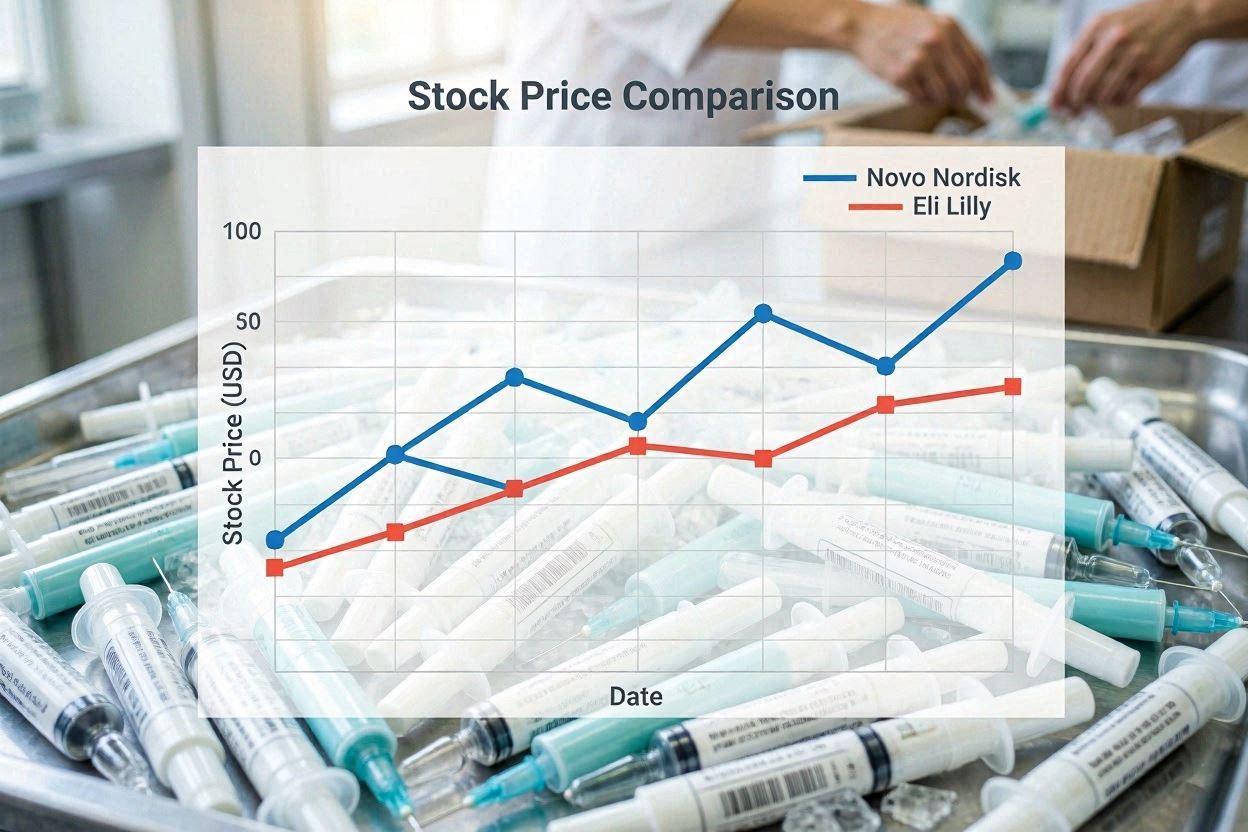
Despite the impending wave of low-cost generics, Novo Nordisk and Eli Lilly continue to trade near historic highs. This resilience is driven by their heavily guarded, next-generation pipelines that generics cannot easily replicate.
- Novo Nordisk’s 'CagriSema': This combination therapy pairs a GLP-1 agonist with an amylin analog. Clinical trials have shown a jaw-dropping 24% average weight loss over 68 weeks.
- Eli Lilly’s 'Retatrutide': Standing as the world’s first triple-hormone agonist (targeting GLP-1, GIP, and glucagon receptors), Retatrutide achieved an unprecedented 30% weight reduction over 104 weeks, widely heralded by Wall Street as the drug that could make bariatric surgery obsolete.
Simultaneously, biotech disruptors like Peptron are working on long-acting formulations designed to sustain weight loss while minimizing the quality-of-life trade-offs, ensuring that the innovation race in this sector remains intensely competitive.
6. Investor's Playbook : The Crypto-to-Bio Barbell Strategy

While the long-term upward trajectory for Novo Nordisk and Eli Lilly is clear, their current valuations undeniably price in a massive premium, making direct entry at all-time highs a psychological hurdle for many investors.
This is where a modern asset rotation strategy excels: exploiting the asymmetric gains of high-beta digital assets like Bitcoin (BTC), Ripple (XRP), Solana (SOL), and Near Protocol (NEAR) to build a bulletproof equity portfolio.
By systematically taking profits from crypto bull runs when altcoins hit pre-determined macro targets, investors can rotate that capital directly into secular bio-megacaps during equity market corrections. This creates a highly optimized Barbell Portfolio: anchoring one side with the explosive, high-growth potential of Web3, and the other side with the unstoppable macro trend of human longevity and biotech innovation.
Aligning your capital with the technologies rewriting human biology and global finance is no longer just an alternative strategy—it is the ultimate playbook for the next decade.
Therefore, I personally avoid investing in assets or stocks where the future value is already fully priced into the market. By seeking out the cyclical lows of high-probability assets whose true value has yet to be recognized and building our positions through disciplined dollar-cost averaging, we can navigate our investment journey with unwavering patience. I am fully convinced that the day will come when extraordinary returns will finally greet us.
[Deep Dive & Insights]
"Curious about the next wave of AI breakthroughs, biotech innovations, and advanced science—and how to translate those shifts into a winning investment mindset? Don't just watch the future unfold. Dive into my exclusive archive of in-depth analyses and discover where the smart money is heading next."
Beyond Reading Glasses: The Science and Reality of Presbyopia Eye Drops
Beyond Reading Glasses: The Science and Reality of Presbyopia Eye Drops
The "Stretch-Arm" Syndrome: Is it Finally Time for a Drop? In your mid-40s, you might notice yourself instinctively holding your phone further away or squinting at restaurant menus. This is 'Presbyopia'—a natural part of aging. For decades, the only solu
cryptoteslaglobal.com
Beyond Landscapes: How Nations Are Turning Alpine Dams and Volcanoes into Digital Gold Reserves
Beyond Landscapes: How Nations Are Turning Alpine Dams and Volcanoes into Digital Gold Reserves
In the high-altitude silence of the Swiss Alps, at 2,500 meters, a concrete dam wall is redefining the future of energy. The Muttsee dam's alpine solar installation isn't just generating electricity; it is proving that geography is not a limit, but a strat
cryptoteslaglobal.com
The Hidden Cost of AI: When Algorithms Drain Our Reservoirs and Power Grids
The Hidden Cost of AI: When Algorithms Drain Our Reservoirs and Power Grids
The Paradigm Shift in AI Anxiety For the past few years, the collective anxiety surrounding Artificial Intelligence has been largely confined to the digital and economic realms. We worried about deepfakes manipulating elections, algorithms plagiarizing art
cryptoteslaglobal.com
The Metamaterials Paradigm Shift : Harnessing Crypto Profits for Next-Gen Tech Stocks
The Metamaterials Paradigm Shift : Harnessing Crypto Profits for Next-Gen Tech Stocks
The convergence of breakthrough scientific research and macro-asset liquidity presents rare, generational investment opportunities. Discover the disruptive potential of Metalens technology and learn how to strategically rotate profits from the upcoming US
cryptoteslaglobal.com